Free supply extended to Ciprofloxacin for meningococcal outbreak
NHS England has issued an operational briefing via its regions to all pharmacies and general practices providing an update on the Meningococcal disease outbreak in Kent and announcing the waiving of NHS prescription charges for prophylactic oral Ciprofloxacin prescriptions issued to patients in relation to the outbreak.
Prescribers in general practices have been asked to endorse NHS prescriptions for oral Ciprofloxacin with the initials ‘FS’ to facilitate its free supply, as already happens in relation to scripts issued for treatments used in the management of tuberculosis (TB) and sexually transmitted infections (STIs).
Free supply of oral Ciprofloxacin to eligible patients (which may be subject to change) includes all those currently affected by the outbreak, specifically:
- All University of Kent students & staff living /working in Halls of residence on Canterbury Campus.
- All those who attended Club Chemistry between 5th – 15th March 2026.
- Sixth forms at schools and colleges where there has been a probable or confirmed case.
- Others identified as close contacts for whom prophylaxis is appropriate.
The prescription charge waiver only applies to FS-endorsed oral Ciprofloxacin prescriptions dispensed and collected between 5th March to 21st April 2026. This may be subject to change as the situation evolves.
Advice for prescribers
According to NHS England, GP clinical IT systems do not have the functionality to add an ‘FS’ endorsement to scripts without there being a reference to TB or STIs as the reason for treatment, and as such any EPS prescriptions issued would therefore result in erroneous coding being included in the patient’s record.
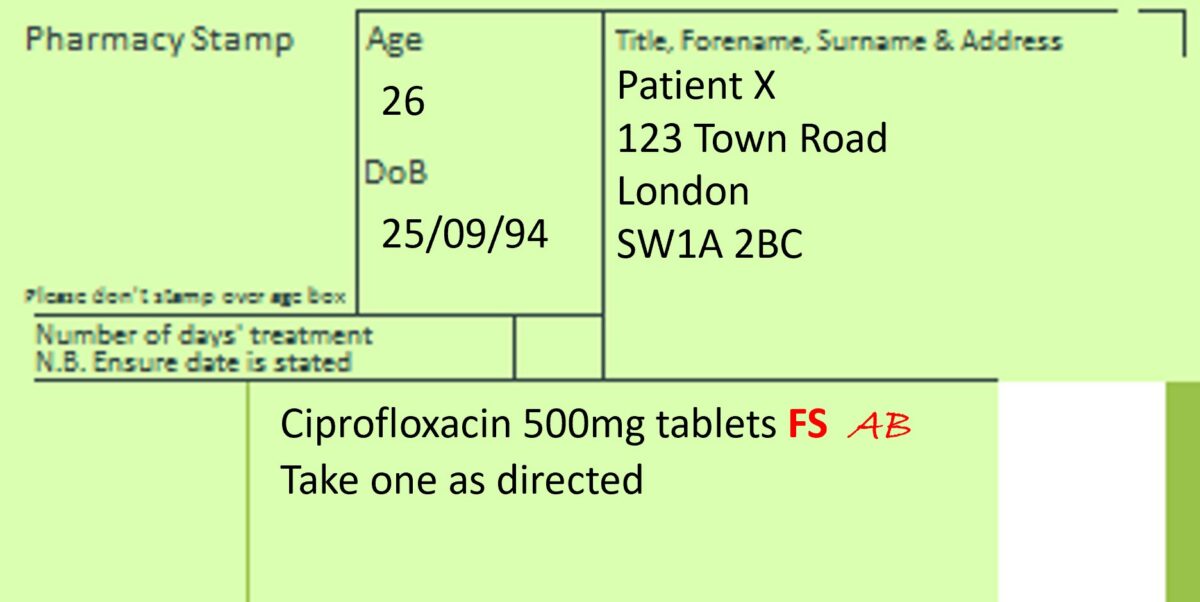
To ensure medical records are accurate and relevant prescriptions are endorsed with ‘FS’ in a way that ensures the item can be dispensed free-of-charge and that will be accepted by the NHS Business Services Authority (NHSBSA), the pragmatic advice to prescribers issuing such prescriptions is to issue a printed or hand-written paper FP10 prescription for Ciprofloxacin (with no other prescription items included on the form), with the ‘FS’ endorsement and prescriber’s initials or signature annotated alongside the prescribed item. The ‘FS’ endorsement can only be added by a prescriber; it CANNOT be added by a patient or a pharmacist.
Example of how the ‘FS’ endorsement countersigned by the prescriber should appear on paper FP10 forms:
Further guidance on how prescribers should apply this endorsement can be found here: NHSBSA Endorsement guidance.
Advice for pharmacy teams
- Pharmacy teams should supply oral Ciprofloxacin free-of-charge to patients provided the item is correctly endorsed with the initials ‘FS’. Whilst this guidance applies to paper FP10 forms, if an FS-endorsed electronic prescription is received for oral Ciprofloxacin this should also be treated as a free-of-charge item and claimed accordingly.
- Paper FP10 prescriptions that include oral Ciprofloxacin with the prescriber ‘FS’ endorsement must be placed in the red separator for end-of-month submission. Prescription processing staff at the NHSBSA will look for the ‘FS’ endorsement on FP10 paper prescriptions and treat the ‘FS’-endorsed item(s) as free-of-charge. Note: there is no ‘FS’ exemption category for patients to select on the reverse of paper FP10 prescription forms so patients are not required to complete or sign the back of FS-endorsed prescriptions for oral Ciprofloxacin.
- Do not supply oral Ciprofloxacin free-of-charge where the ‘FS’ endorsement is missing or has been incorrectly applied by the prescriber (including on EPS scripts where ‘FS’ is included as part of the dosage instructions). Where a prescription is presented without the ‘FS’ endorsement or where the endorsement has been incorrectly applied, the patient should be asked to pay a prescription charge (unless exempt from paying charges for other reasons, e.g. has a valid medical exemption certificate) and provided with an FP57 receipt and refund form and/or a till receipt to support a refund claim.
- Pharmacy teams cannot retrospectively issue an FP57 form to patients. An FP57 form can only be provided by the pharmacy on the date of dispensing. If an FP57 form was not requested or issued by the pharmacy at the time the oral Ciprofloxacin item was dispensed and collected by the patient, the pharmacy should advise the patient to contact the NHSBSA to request a refund (see Refunds section below).
- Pharmacy teams should not issue prescription charge refunds for oral Ciprofloxacin to patients presenting with completed FP57 forms. All refund requests for oral Ciprofloxacin should be directed to the NHSBSA (see Refunds section below).
Read our guidance on how pharmacy teams should correctly submit ‘FS’ endorsed prescriptions.
After the date an oral Ciprofloxacin prescription related to the Kent outbreak is dispensed and collected, if a patient from the affected cohort has already paid a prescription charge and requests a refund, they should be advised to email the NHSBSA (hc5refundquery@nhsbsa.nhs.uk) to request a refund. Patients should include a covering letter outlining their circumstances and their proof of payment (an FP57 form or till receipt), where they retained this. Alternatively patients can telephone NHSBSA helpdesk on 0300 330 1343. If a patient presents a completed FP57 form and/or till receipt at a pharmacy to obtain a refund of NHS prescription charges paid for oral Ciprofloxacin, the patient should be signposted to the NHSBSA as there is no mechanism for pharmacies to process refunds due to missing or incorrect ‘FS’ endorsements on NHS prescriptions. All other FP57 refund requests can continue to be processed in the usual way.
Worried students, parents or members of the public may seek advice from their community pharmacy in relation to the outbreak. If an individual believes they may have been exposed, please advise them to follow UKHSA instructions rather than seeking private antibiotics. Community pharmacy teams are advised to remain vigilant for symptoms of meningococcal disease. Symptoms may include: Anyone presenting with symptoms suggestive of meningitis (this could include patients referred into Pharmacy First through the usual pathways) or rapidly deteriorating illness, should be directed to urgent care via 999 or A&E for immediate emergency assessment. A patient helpline, run by UKHSA, is now available for general enquiries. Patients can phone 0344 225 3861, Monday to Friday from 9am to 5pm if they have no symptoms but are concerned they have been in contact with a confirmed case.