Special containers and products requiring reconstitution
Published on: 3rd July 2013 | Updated on: 24th September 2026
The Human Medicines Regulations 2012 (HMRs) require prescription only medicines to be supplied in accordance with the prescription. In practice, this means pharmacists should supply the exact quantity prescribed, except in certain circumstances.
The HMRs include provisions for Original Pack Dispensing (OPD), which allow pharmacists to supply up to 10% more or less than the quantity prescribed, as well as exceptions where the +/-10% limit does not apply. These exceptions are relevant to products classed as special containers and are explained in more detail below.
Separate reimbursement arrangements also apply to certain oral liquids requiring reconstitution.
This page explains the requirements for supplying special containers and certain oral liquids requiring reconstitution, how reimbursement is calculated, and the relevant endorsement and prescription submission requirements.
The Human Medicines (Amendment Relating to Original Pack Dispensing) (England and Wales and Scotland) Regulations 2023 amended the HMRs to introduce Original Pack Dispensing (OPD). The amendments also set out circumstances where the +/-10% OPD limit does not apply. These are where:
- the medicine is in a form that makes it not practicable to dispense the exact quantity ordered;
- the medicine is in a container that has an integral means of application or from which it is not practicable to dispense an exact quantity; or
- the medicine cannot be dispensed in the quantity ordered without adversely affecting the medicine.
In these circumstances, pharmacists can supply the medicine in the relevant complete pack or sub-pack, even where this results in supplying more or less than 10% of the quantity prescribed.
For more information on OPD, including the products and prescriptions in scope, see our Original Pack Dispensing webpage.
Community Pharmacy England is working with the Department of Health and Social Care (DHSC) to align the existing special container arrangements with these HMR requirements. While this work is ongoing, products continue to be assessed for special container status against the criteria set out in Part II Clause 10B of the Drug Tariff.
A product can be classed as a special container in its complete original pack size or sub-pack size.
Where the quantity ordered does not coincide with the special container pack or sub-pack size, pharmacy teams should supply the special container or combination of containers nearest to the quantity ordered and endorse the prescription with the number and size of the containers supplied.
Where the quantity ordered falls exactly halfway between two containers, pharmacy teams should round down and supply the nearest complete container.
Where there is an overriding clinical requirement to supply the exact quantity prescribed, the pharmacist should assess whether it is appropriate to split the special container. See ‘Supplying the exact quantity prescribed’ below for further information.
Examples
| Drug name and quantity prescribed | Drug Tariff listed pack size(s) | Quantity supplied under special container rules | Quantity reimbursed |
| Tacrolimus 5mg capsules – 28 capsules | 50 capsules | 50 capsules – as this is the nearest complete container to the quantity ordered | 50 capsules |
| Tacrolimus 5mg capsules – 75 capsules | 50 capsules | 50 capsules – as the quantity ordered falls exactly halfway between two containers, the half-way rule applies and the quantity is rounded down | 50 capsules |
| Tacrolimus 5mg capsules – 80 capsules | 50 capsules | 100 capsules (2 x 50) – as this is the nearest combination of complete containers to the quantity ordered | 100 capsules |
| Betamethasone dipropionate 0.05% / Salicylic acid 3% ointment – 50g | 30g and 100g | 60g (2 × 30g) – as this is the nearest combination of complete containers to the quantity ordered | 60g |
In a small number of cases there may be an overriding clinical requirement to supply the exact quantity prescribed rather than the nearest complete pack or sub-pack under the special container arrangements. For example, this may apply where the medicine needs to be packaged into a multi-compartment compliance aid or if there is a risk that the patient may misuse the medicine.
In these circumstances, the pharmacist should assess whether it is clinically appropriate to split the pack, taking into account the individual needs of the patient and the stability of the medicine once removed from its original packaging.
There may also be patient safety considerations where a special container is split. If a hygroscopic medicine is not stored and used correctly, for example, exposure to moisture could affect the integrity of the medicine by decreasing its stability and/or efficacy.
Where there is a clinical requirement to supply the exact quantity ordered rather than the nearest complete pack or sub-pack size, no quantity endorsement is required as the quantity supplied is not at variance with the quantity ordered. Where a pack size endorsement is required, for example where multiple pack sizes are listed in the Drug Tariff, pharmacy teams should endorse the pack size from which the order was supplied.
Reimbursement will continue to be calculated in accordance with the special container rules, regardless of the quantity supplied.
Special containers – Part II Clause 10B
Part II Clause 10B of the Drug Tariff states:
Where the quantity ordered by the prescriber does not coincide with that of an original pack and the drug or chemical reagent is:
- Sterile
- Effervescent or hygroscopic, or
- a. Liquid preparations for addition to bath water
- b. Coal Tar preparations
- c. Viscous external preparations
- Packed in a castor, collapsible tube, drop-bottle, pressurised aerosol, puffer pack, roll-on-bottle, sachet, shaker, spray, squeeze pack, container with an integral means of applications or any other container form which it is not practicable to dispense the exact quantity
- Semisodium Valproate, Sodium Valproate, Valproic Acid:
the contractor shall supply in the special container or containers the quantity nearest to that ordered and endorse the prescription form with the number and size of those containers. Although payment will normally be based on the quantity nearest to that ordered, some items are available in a larger size pack or container than that normally required pursuant to orders on prescription forms. Where the amount ordered on a prescription form, or the frequency of supply, justifies supply from such larger size pack or container, payment will be based on the cost of that larger size in the absence of endorsement. However, for valproate/valproic acid prescriptions, the “quantity nearest” rule will always apply.
If the ordered quantity lies exactly halfway between two different pack sizes, payment will be based on the smaller pack size. The exception to this are products that require reconstitution where the payment will be based on the nearest pack or number of packs necessary to cover the quantity ordered.
Please note: Licensed preparations of semisodium valproate, sodium valproate and valproic acid are subject to specific complete pack dispensing requirements. See ‘Valproate-containing products – complete pack dispensing requirements’ below for further information.
Products requiring reconstitution – Part II Clause 13
Part II Clause 13 of the Drug Tariff states:
- This clause applies to antibacterial, antiviral or antifungal preparations listed in 5.1, 5.2 and 5.3 (except 5.3.1) of the British National Formulary (BNF), which are for oral administration and requires reconstitution from granules or powder.*
- When the quantity reconstituted from an original pack or packs is unavoidably greater than the quantity ordered and it has not been possible for the contractor to use the remainder for or towards supplying against another prescription, payment will be calculated from the Basic Price of the preparation and will be based on the nearest pack or number of packs necessary to cover the quantity ordered.
*Please note: The current BNF no longer uses the numbered chapter structure cited in Part II Clause 13 of the Drug Tariff. The reference to sections 5.1, 5.2 and 5.3 (except 5.3.1) is retained above as it reflects the wording of the Drug Tariff.
For these products, enough packs should be supplied to cover the quantity prescribed. For further information, see ‘Products requiring reconstitution – how the rules differ from special container rules’ below.
All licensed medicines containing sodium valproate, valproic acid and semisodium valproate are classified as special containers and must be supplied in complete manufacturer’s original packs, unless the requirements for the individual patient exception described below are met.
Where the quantity ordered on a prescription does not coincide with an original pack size or a multiple of pack sizes, the nearest number of complete packs will be reimbursed (either rounded up or down; rounded down when the quantity prescribed is exactly halfway between two complete pack sizes). Pharmacy teams are not required to endorse the prescription; reimbursement will be based on the relevant number of complete packs.
The manufacturer’s original packs include specific warnings and pictograms on the labelling, including a patient card, along with the statutory patient information leaflet (PIL) and an additional patient booklet, which highlight the risks of taking valproate during pregnancy. Supplying complete packs of medicines containing valproate ensures patients receive the important safety information contained within the original pack.
Individual patient exception
Pharmacists can make an exception to supplying complete packs of medicines containing valproate on an individual patient basis where a risk assessment is in place that refers to the need for the medicine to be supplied in different packaging (for example, in a multi-compartment compliance aid) and processes are in place to ensure the patient receives the PIL.
The Medicines and Healthcare products Regulatory Agency (MHRA) has published information on the exceptional circumstances where an original pack is not required to be supplied. The guidance can be found at: Full pack dispensing of valproate-containing medicines.
The requirement to supply medicines containing valproate in complete original packs was introduced in October 2023 following recommendations made by the Independent Medicines and Medical Devices Safety Review and a public consultation on Original pack dispensing and supply of medicines containing sodium valproate. The Human Medicines (Amendment Relating to Original Pack Dispensing) (England and Wales and Scotland) Regulations 2023 amended the Human Medicines Regulations 2012 to require licensed medicines containing valproate to be supplied in the manufacturer’s original full pack, subject to the individual patient exception described above. The special container criteria outlined in Part II Clause 10B of the Drug Tariff were also updated to align with this requirement.
These changes were introduced alongside wider amendments relating to Original Pack Dispensing (OPD). However, medicines classed as special containers, including valproate-containing medicines, are outside the scope of the OPD +/-10% rules and continue to be supplied and reimbursed under the special container arrangements. For more information on OPD, including the products in scope and reimbursement arrangements, see our Original Pack Dispensing webpage.
The reimbursement rules for eligible oral liquids requiring reconstitution under Part II Clause 13 of the Drug Tariff differ from the special container rules. Please note: The current BNF no longer uses the numbered chapter structure cited in Part II Clause 13 of the Drug Tariff. The reference to sections 5.1, 5.2 and 5.3 (except 5.3.1) is retained above as it reflects the wording of the Drug Tariff.
For eligible oral anti-infective products that require reconstitution from granules or powder, enough packs should always be supplied to cover the prescribed quantity. The special container rule to round down where the quantity falls exactly halfway between two pack sizes does not apply. This may result in more medicine than is needed being reconstituted where the remainder cannot be used to fill another prescription.
Reimbursement will be based on the pack or number of packs needed to cover the prescribed quantity.
For information on endorsement requirements, see ‘Endorsement and submission requirements‘ below.
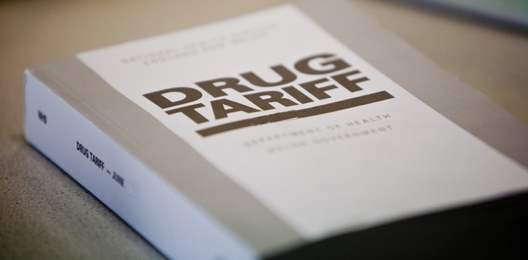
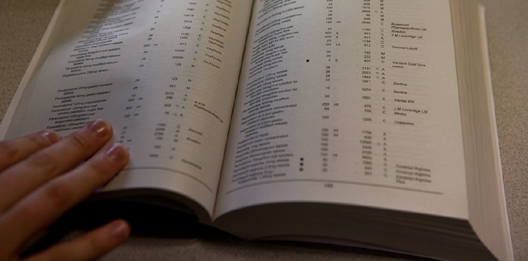
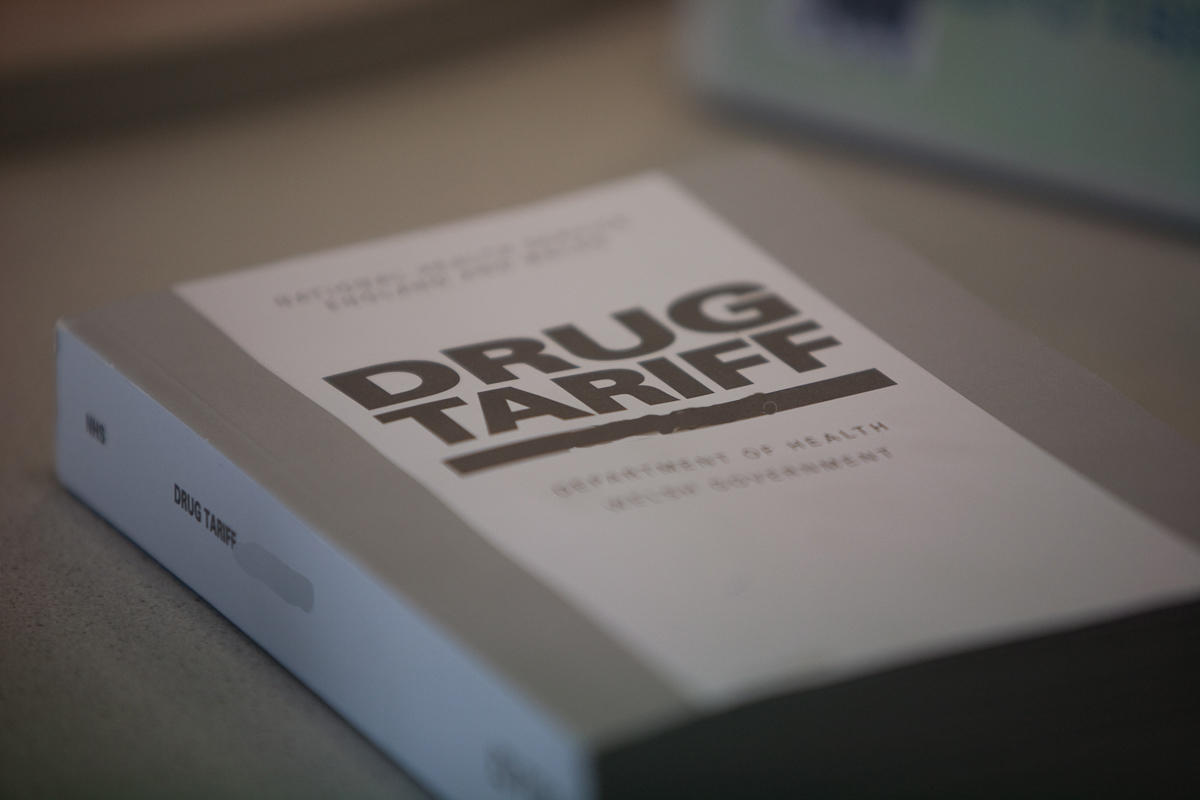
Products classed as special containers in the Drug Tariff are marked with a small black square (◼) next to the drug name, for example:

Eligible oral anti-infective products that require reconstitution from granules or powder are marked with a small black circle (•) next to the drug name in the Drug Tariff, for example:

Examples taken from August 2026 Drug Tariff
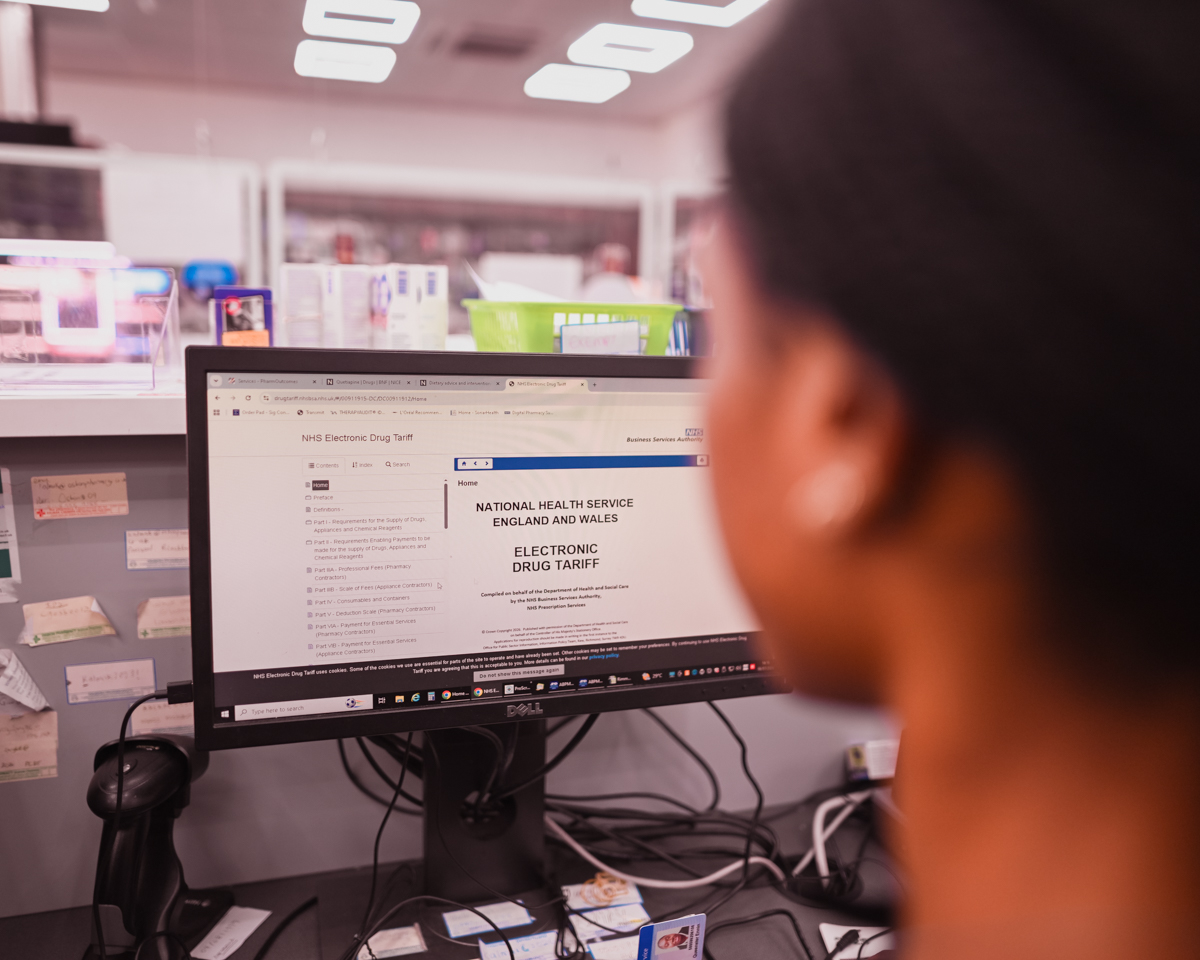
To confirm the special container status of a product not listed in the Drug Tariff, pharmacy teams can check the NHS Dictionary of Medicines and Devices (dm+d) browser, which is updated weekly by NHSBSA.
Pharmacy IT systems should also identify products classed as special containers and indicate the number of packs or sub-packs to supply. Pharmacy teams should check with their pharmacy IT supplier how frequently dm+d updates are incorporated into their system.
Community Pharmacy England’s special container database provides information on products recognised by NHSBSA as having special container status, including whether this applies at complete pack or sub-pack level. The database is updated monthly.
Details of products that have been re-classified as special containers following a review of their special container status can be found on our Notice of changes to special container status of products page.
Special containers
For products classed as special containers, pharmacy teams are required to endorse the prescription with the number and size of the containers supplied.
Where there is a clinical requirement to supply the exact quantity ordered rather than the nearest complete pack or sub-pack size, no quantity endorsement is required as the quantity supplied is not at variance with the quantity ordered. Where a pack size endorsement is required, for example where multiple pack sizes are listed in the Drug Tariff, pharmacy teams should endorse the pack size from which the order was supplied.
Products requiring reconstitution
For eligible oral anti-infective products that require reconstitution, no specific endorsement is required. NHSBSA will automatically calculate reimbursement based on the nearest pack or number of packs necessary to cover the quantity ordered.
Sorting and submission
There are no specific requirements for sorting these prescriptions separately, unless the prescription meets one of the criteria for inclusion in the red separator.
Q. I have received a prescription for Tacrolimus 5mg capsules x 40 capsules. What quantity will I be reimbursed for?
A. Tacrolimus 5mg capsules are available in a pack size of 50 capsules, which is classed as a special container. Where the quantity prescribed does not coincide with the special container pack size, reimbursement is based on the nearest complete container or combination of containers. For a prescription ordering 40 capsules, reimbursement will therefore be based on 50 capsules.
Q. I have received a prescription for Ibuprofen 10% gel x 30g, but only the 100g pack size is listed in Part VIIIA of the Drug Tariff. What will I be reimbursed for?
A. Ibuprofen 10% gel is available in 30g, 40g, 50g and 100g pack sizes, all of which are classed as special containers. However, only the 100g pack size is listed in Part VIIIA of the Drug Tariff.
For a prescription ordering 30g, reimbursement will be based on the listed 100g pack size. However, the special container rules require the special container or combination of containers nearest to the quantity ordered to be supplied; in this example, this is the 30g pack.
Community Pharmacy England recommends clearly endorsing the prescription with the pack size used.
Q. I have received an FP10 prescription for Erythromycin 40mg/ml / Zinc acetate 12mg/ml lotion x 90ml. This product is available in packs of 30ml and 90ml; both sizes are listed in the Drug Tariff and are classed as special containers. I have supplied three packs of 30ml. Can I endorse the prescription with ’90ml’?
A. No. If only ’90ml’ is endorsed, NHSBSA may interpret this as the pack size used and reimbursement could be based on one 90ml pack rather than three 30ml packs.
The prescription should be endorsed with the amount dispensed over the pack size used. In this example, the prescription should therefore be endorsed ‘90ml/30ml’.
Q. I have received a prescription for Amoxicillin 125mg/5ml oral suspension x 140ml. How will reimbursement be calculated?
A. The pharmacy owner will be reimbursed for two 100ml packs.
Amoxicillin 125mg/5ml oral suspension is reimbursed in line with the rules set out in Part II Clause 13 of the Drug Tariff – Reconstitution of certain oral liquids. Under these rules, enough packs should be supplied to cover the quantity prescribed. Reimbursement will be calculated automatically based on the nearest pack or number of packs necessary to cover the quantity prescribed.
Q. I have received a prescription for Mebendazole 100mg/5ml oral suspension x 10ml. What quantity will I be reimbursed for?
A. Mebendazole 100mg/5ml oral suspension is available in a 30ml pack, which is classed as a special container. Where a prescription orders 10ml, the pharmacy owner will be reimbursed for the complete 30ml pack.
Where the quantity supplied exceeds the quantity prescribed, the patient should be advised to take only the quantity prescribed. Any remaining medicine should be returned to a pharmacy for safe disposal.
Q. I have received a prescription for Pregabalin 20mg/ml oral solution sugar free x 300ml. What quantity will I be reimbursed for?
A. The pharmacy owner will be reimbursed for the complete 473ml pack.
Pregabalin 20mg/ml oral solution sugar free comes in a pack size of 473ml which is classed as a special container. As pregabalin is a Schedule 3 Controlled Drug, the prescribed quantity of 300ml should be supplied and the remainder should be safely disposed of.
Due to the nature of the product packaging and method of administration, it may be advisable for prescribers to review prescribing quantities to avoid split packs, where clinically appropriate.
It is good practice to clearly endorse the prescription with the amount dispensed over the pack size used.
Q. How do I report a drug which I believe should have special container status but does not have the marker in the Drug Tariff or dm+d?
A. If you identify a product that is not currently classed as a special container but you believe meets one or more of the special container criteria set out in Part II Clause 10B of the Drug Tariff, please notify Community Pharmacy England’s Dispensing and Supply Team (0203 1220 810 or ds.team@cpe.org.uk).
The team will investigate and assess whether the product meets the relevant criteria. Where appropriate, Community Pharmacy England will submit an application to NHSBSA and DHSC seeking a re-determination of the special container status for the product.
Q. Can unlicensed specials be classed as special containers?
A. Yes. Unlicensed specials can be classed as special containers where the relevant criteria are met. If a pharmacy receives a prescription for an unlicensed special that is classed as a special container, the usual special container reimbursement rules will apply.
Q. Do drugs with limited stability once opened automatically qualify as special containers?
A. No. Limited stability after first opening does not automatically qualify a drug for special container status. The product must meet the relevant special container criteria. Separate reimbursement arrangements apply to eligible oral anti-infective products that require reconstitution under Part II Clause 13 of the Drug Tariff.
Due to the nature of products with limited stability, it may be advisable for prescribers to review prescribing quantities to avoid split packs, where clinically appropriate.
Q. I have received a prescription for 2 x 100ml Amoxicillin 125mg/5ml oral suspension. Due to the product’s limited stability following reconstitution, the patient will need to return to collect the second bottle. Will I receive an additional fee for the second dispensing episode?
A. No. Only one Single Activity Fee will be paid even where multiple dispensing episodes are made against the same prescription item.
Where this occurs, it may be appropriate for the pharmacy team to discuss with the prescriber whether separate prescriptions could be issued to recognise the need for more than one dispensing episode due to the product’s limited stability.
Q. Can I supply the exact prescribed quantity if this is different to the special container pack or sub-pack size?
A. In certain circumstances, yes. Where there is an overriding clinical requirement to supply the exact quantity prescribed rather than the nearest complete pack or sub-pack size, pharmacists would need to assess the clinical appropriateness of splitting the pack.
See ‘Supplying the exact quantity prescribed’ above for further information.
Q. If I supply the exact quantity prescribed rather than the nearest special container pack or sub-pack size, will reimbursement be based on my endorsement?
A. No. Where a pharmacist uses their professional discretion to supply the exact quantity prescribed, reimbursement will still be calculated in accordance with the special container rules, regardless of the quantity endorsed.
This may mean that the pharmacy owner is reimbursed for a quantity that is more or less than the quantity prescribed and supplied.
Q. I have a prescription for an individual product that is only available as part of a combination or titration pack. How will I be reimbursed?
A. Combination and titration packs are classed as special containers. Where the prescribed product is only available as part of a combination or titration pack, reimbursement will be based on the number of complete packs required to fulfil the prescription.
Q. Why are medicines containing valproate classed as complete-pack special containers?
A. Complete-pack dispensing of medicines containing valproate was introduced to ensure patients receive the important safety information contained within the manufacturer’s original pack. This includes specific warnings and pictograms on the labelling, a patient card, the statutory patient information leaflet (PIL) and an additional patient booklet, which highlight the risks of taking valproate during pregnancy.
See ‘Valproate-containing products – complete pack dispensing requirements’ above for further information.
Q. Can medicines containing valproate be supplied in a Monitored Dosage System (MDS)?
A. In certain circumstances, yes. Pharmacists can make an exception to supplying medicines containing valproate in complete original packs where an individual risk assessment identifies the need for the medicine to be supplied in different packaging, for example, in a Monitored Dosage System (MDS). Processes must also be in place to ensure a patient information leaflet (PIL) is supplied.
Pharmacists should also consider the stability of the medicine once removed from its original packaging. For example, Epilim Chrono 200 tablets are hygroscopic and sensitive to moisture. The SPC states that the tablets should not be removed from their foil until immediately before they are taken.
See ‘Valproate-containing products – complete pack dispensing requirements’ above for further information. Further guidance on the stability of medicines in compliance aids is available from the Specialist Pharmacy Service.



For more information on this topic please email comms.team@cpe.org.uk