
Repeat Dispensing and eRD
Published on: 10th July 2013 | Updated on: 17th August 2026
Around two-thirds of prescriptions issued in primary care are for people who take regular medicines.
Repeat Dispensing allows people to receive repeat supplies of their NHS medicines without needing a new prescription from their GP practice each time. Most Repeat Dispensing is now managed electronically through the Electronic Prescription Service (EPS) and is known as electronic Repeat Dispensing (eRD).
eRD can help:
- Reduce workload for GP practices;
- Save time for patients;
- Improve access to regular medicines; and
- Support pharmacy teams to play a greater role in helping people manage their medicines safely.
As part of the service, pharmacy teams:
- Dispense Repeat Dispensing prescriptions issued by prescribers;
- Check that each supply is still needed; and
- Identify any concerns that may require referral back to the prescriber.
eRD is now the main way Repeat Dispensing is delivered because it is more efficient and convenient for patients, prescribers and pharmacy teams.
Click on a heading below for more information.
eRD allows a patient to receive repeat supplies of medicines or appliances without a prescriber having to issue a new prescription every time.
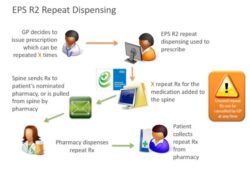
When creating an eRD prescription, the prescriber authorises a series of prescription issues. Each issue contains the same prescribed items and can support treatment for up to 12 months.
In addition to the information included on a standard EPS prescription, an eRD prescription includes:
- The intended interval between each issue; and
- The number of authorised issues.
The issues are then made available electronically to the patient’s nominated pharmacy at the appropriate time.
Prescribers may also provide a repeatable prescription authorising token. This can help patients understand how many issues have been authorised, but it is not needed to collect medicines from the nominated pharmacy.
Service specification
The contractual requirements for Essential services were originally set out in The National Health Service (Pharmaceutical and Local Pharmaceutical Services) Regulations 2013.
The original Repeat Dispensing service specification was published before eRD was introduced and therefore refers only to paper Repeat Dispensing.
Repeat Dispensing service specification
When will the pharmacy receive each issue?
NHS Spine services manage the release of each issue.
The first issue becomes available immediately. Subsequent issues are created on the NHS Spine and released at the appropriate time.
To support advance preparation, the Spine automatically sends the next issue to the nominated pharmacy seven days before the expected end date of the previous issue.
Pharmacy teams may also be able to download issues earlier when clinically appropriate, for example if a patient is going on holiday. Individual IT systems may include additional scheduling options to support pharmacy workflows.
What should pharmacy teams do before supplying medicines?
Before supplying an issue, pharmacy teams should check that:
- The patient is still taking or using the medicine appropriately; and
- There are no reasons why the medicine should not be supplied.
This can be done by asking the patient or their representative a small number of questions.
Community Pharmacy England Briefing 004/17: eRepeat Dispensing – a factsheet for pharmacy teams includes:
- Suggested patient questions; and
- Key messages to help promote eRD.
What happens after the last issue is dispensed?
Once all authorised issues have been supplied, the prescription series ends.
The patient will need a new Repeat Dispensing prescription series and should contact their GP practice or prescriber in good time.
Pharmacy teams should remind patients when they are collecting the final issue in a series.
Can patients change their nominated pharmacy?
Yes.
Patients can change their nomination at any time. Any outstanding eRD issues that have not yet been downloaded will transfer to the new nominated pharmacy.
This is different from paper Repeat Dispensing, where all issues must be obtained from the same pharmacy.
How do I endorse, submit and reconcile eRD prescriptions?
Visit our EPS submission page.
Remember that all eRD issues must be claimed within 365 days of the prescriber’s original signature date.
Training
All pharmacists working in community pharmacy should understand how eRD operates.
Useful training resources include:
- CPPE Repeat Dispensing e-learning and e-assessment; and
- Training materials provided by your IT system supplier.
Pharmacy staff also need to understand how eRD functions within their own IT system. Your IT system supplier can provide guidance and training.
eRD prescriptions are processed in a similar way to other EPS prescriptions. Related guidance is available on:
- Enhancing EPS or preparing for it;
- Dispensing (EPS);
- Business continuity (EPS); and
- Submission (EPS).
Resources
- Community Pharmacy England Briefing: eRepeat Dispensing – a factsheet for pharmacy teams;
- Claiming for EPS prescriptions on time factsheet;
- EPS and eRD statistics; and
- NHS Business Services Authority (NHSBSA) eRD guidance.
eRD factsheets
Pharmacy owners must ensure that appropriate advice about Repeat Dispensing is offered to patients who:
- Have a long-term stable condition; and
- Need regular medicines for that condition.
Where appropriate, patients should be encouraged to discuss Repeat Dispensing with their prescriber.
Pharmacy teams can promote eRD by:
- Explaining the service and its benefits during routine conversations; and
- Providing patient information leaflets.
Patient resources
- Community Pharmacy England eRD poster (PDF);
- Community Pharmacy England eRD poster (Word);
- Community Pharmacy England eRD leaflet (PDF);
- Community Pharmacy England eRD leaflet (Word);
- NHSBSA eRD webpage for patients; and
- Community Pharmacy England Briefing 004/17: eRepeat Dispensing – a factsheet for pharmacy teams.
Referring suitable patients
If a pharmacy team identifies a patient who may benefit from eRD, and the patient agrees, the team can refer them to their GP practice.
Available referral forms:
- Repeat Dispensing/eRD referral form (electronic Word form);
- Repeat Dispensing/eRD referral form (Word); and
- Repeat Dispensing/eRD referral form (PDF).
Example social media posts
- Pharmacies in [local area] can help you manage repeat prescriptions using electronic Repeat Dispensing (eRD). Ask your pharmacy team or GP practice whether eRD could be right for you. #thinkpharmacy
- Did you know that electronic Repeat Dispensing (eRD) can help you receive regular medicines without needing to order a prescription every time? Ask our team for more information. #thinkpharmacy
- Electronic Repeat Dispensing (eRD) helps make managing regular prescriptions simpler and more convenient. Ask your pharmacy team how it works. #thinkpharmacy
- [Percentage]% of eligible repeat prescriptions in [local area] were supplied using eRD last year. Ask your pharmacy team about the benefits of eRD. #thinkpharmacy
Q. Is patient consent required to use eRD for repeat prescriptions?
No. Explicit consent had been required a long time ago, but that requirement was permanently removed back in 2021.
Q. How long does a Repeat Dispensing prescription remain legally valid?
For medicines that are not Schedule two or Schedule three Controlled Drugs, the first supply must take place within six months of the appropriate date. Subsequent issues remain valid for up to 12 months from the prescribing date.
For Schedule 4 Controlled Drugs, the first supply must occur within 28 days of the appropriate date. Subsequent issues remain valid for up to 12 months.
Schedule 2 and Schedule 3 Controlled Drugs cannot be prescribed using Repeat Dispensing.
Schedule 5 Controlled Drugs follow the same validity rules as non-Controlled Drugs.
Q. A patient is going on holiday. Can I dispense two issues together?
Yes, where the prescriber has not specified an interval and using professional judgement indicates this is appropriate. The issues must still be downloaded and processed in sequence.
Q.Is a Repeat Authorisation (RA) form required for eRD?
No. eRD uses electronic authorisation. A patient may have a repeatable prescription authorising token, but this is not required for dispensing.
Q. What is a repeatable prescription authorising token?
It is a token that shows how many issues have been authorised. It is provided for information only and is not required to collect medicines.
Q. Do pharmacy teams need to see the token before dispensing?
No.
Q. Why does paper Repeat Dispensing use an RA form but eRD does not?
Paper Repeat Dispensing relies on a handwritten signature. eRD uses an electronic signature and electronic authorisation, removing the need for a separate RA form.
Q. How is exemption information recorded for eRD?
The correct payment or exemption category must be entered into the pharmacy IT system.
Where a declaration is required, it must be recorded for each issue. Relevant declaration tokens must be submitted to NHSBSA where required for audit purposes.
Q. How is the dispensing pharmacy determined?
eRD prescriptions are sent to the patient’s nominated pharmacy. Patients can change their nomination at any time, and any non-downloaded issues will transfer to the new nominated pharmacy.
Q. Can issues be cancelled?
Yes. Prescribers can cancel and replace an eRD series if circumstances change.
If a prescription has already been downloaded to a pharmacy system, the prescriber should contact the pharmacy directly to prevent supply.
More information is available on our EPS prescription cancellation guidance.
Q. Does a patient pay an NHS prescription charge for every eRD issue?
Yes. If a patient is not exempt from NHS prescription charges, charges apply to each issue supplied.
Patients who regularly pay prescription charges may benefit from an NHS Prescription Prepayment Certificate (PPC).
Although eRD is now the main method of Repeat Dispensing, pharmacy owners may occasionally receive paper Repeat Dispensing prescriptions.
How does paper Repeat Dispensing work?
Paper Repeat Dispensing uses:
- A Repeat Authorisation (RA) form; and
- A series of Repeat Dispensing (RD) batch issue forms.
The RA form contains the prescribing details, number of issues and dispensing interval. It must be signed by the prescriber and should display “RA” on the form.
The associated RD forms contain the same prescribing information and should display “RD” on the form.
RD forms are not signed. Instead, they include wording such as “Repeat Dispensing: one of six” or “three of 12”.
The maximum number of issues that can be included is equivalent to up to one year of treatment.
Endorsing paper Repeat Dispensing prescriptions
Each RD form should be endorsed in line with Drug Tariff requirements.
Each form should also:
- Be stamped with the pharmacy stamp; and
- Include the dispensing date.
RA forms do not need endorsing, but pharmacies must maintain a clear audit trail.
Submitting paper Repeat Dispensing prescriptions
RD forms
Dispensed RD forms should be submitted to NHSBSA each month within the correct prescription bundle.
Initial issues (for example, one of six) must be sorted separately from later issues.
Undispensed RD forms should not be submitted.
RA forms
RA forms should be submitted in the month when:
- All authorised issues have been supplied; or
- The prescription series is no longer required.
If RA forms are submitted, remember to tick the appropriate declaration box on the FP34C submission form.
For more information on this topic please email services.team@cpe.org.uk