EPS technical issues and contingency arrangements
Published on: 20th July 2015 | Updated on: 22nd July 2026
Technical issues can sometimes affect the Electronic Prescription Service (EPS). When this happens, pharmacy teams need to understand the available options so that patients can continue to access their medicines safely and efficiently.
Having a clear business continuity plan can help reduce disruption and support patient care during technical outages.
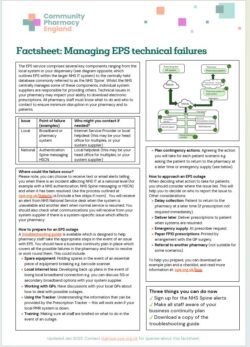
A summary managing technical failures factsheet is available which explains how to identify and manage common EPS technical issues.
Key areas to consider include:
- Identifying whether the issue is local or national;
- Understanding which part of the system is affected; and
- Knowing who to contact for support.
Contact your local support team
If you experience an EPS-related technical issue:
- Independent pharmacy owners should contact their IT system supplier helpdesk;
- Pharmacy teams working within larger organisations should follow local procedures and contact their head office or internal IT support team.
Your support team can help diagnose the issue and advise on next steps.
Is the issue local or national?
Your support team should be able to establish whether the problem is:
- A local issue, such as broadband failure, a GP practice system issue, or a pharmacy system problem; or
- A national issue affecting EPS or wider NHS digital services.
Top tip
Whenever you contact a helpdesk:
- Record the call reference number; and
- Note the name of the person you spoke with.
This information can be helpful if follow-up support is needed.
Which part of the service is affected?
Your support team can usually identify whether the issue relates to:
- GP practice systems;
- Pharmacy systems;
- Smartcards or authentication tools;
- Prescription token printers;
- Dispensing token printers;
- Network connectivity; or
- National NHS systems.
Escalation of technical issues
Your local support team is responsible for escalating technical issues through the appropriate support channels where required.
Smartcard issues
Problems with Smartcards, such as locked, damaged or expired cards, should be reported to your local Registration Authority (RA).
If an EPS prescription cannot be accessed, pharmacy teams should use their professional judgement to determine the most appropriate option based on the patient’s circumstances and the urgency of the supply.
Possible options include:
- Asking the patient to return later if the medicine is not needed immediately;
- Delivering medicines once systems are restored;
- Arranging an emergency supply at the request of the prescriber;
- Requesting a paper FP10 prescription from the GP practice where appropriate; or
- Referring the patient to another pharmacy if suitable and practical.
Patient safety should remain the primary consideration when deciding the best course of action.
Every pharmacy should have a business continuity plan that includes procedures for managing EPS disruption.
Our Business Continuity Template can help pharmacy owners develop or update their local arrangements.
You may also wish to store a copy of your EPS troubleshooting guide in an easily accessible location so that pharmacy team members can quickly refer to it during a system failure.
Key considerations during an outage
Consider:
- Which part of the service has failed; and
- Whether there is an estimated resolution time.
Possible contingency arrangements
Depending on the nature of the problem, options may include:
- Mobile connectivity backup – Consider whether a 4G or 5G backup connection would support business continuity during local internet outages;
- Alternative prescribing arrangements – Where appropriate, the GP practice may provide a paper FP10 prescription. Any associated electronic prescription should be cancelled to prevent duplicate supplies;
- Emergency supply arrangements – These may be used where legislation and professional requirements allow;
- Delayed collection – The patient returns once systems are restored;
- Later delivery – Medicines are supplied when the issue has been resolved;
- Alternative pharmacy arrangements – The patient may be able to use another EPS-enabled pharmacy, depending on the prescription status and local circumstances;
- Updating records later – Some administrative tasks, such as nomination updates or sending dispensing notifications, may be completed once systems become available again;
- Service level agreements (SLAs) – Pharmacy owners may wish to review connectivity and support arrangements with suppliers to minimise future disruption.
Planning ahead
Effective business continuity planning can help:
- Reduce disruption to patients;
- Improve resilience during outages;
- Support compliance with contractual and professional requirements; and
- Minimise pressure on pharmacy teams during technical incidents.
Related resources:
- Understanding possible points of EPS system failure;
- EPS business continuity guidance;
- NHS national service status information;
- Smartcards and NHS Care Identity Service guidance; and
- Community Pharmacy England business continuity resources.
For more information on this topic please email it@cpe.org.uk