Cross-border dispensing of prescriptions
Published on: 7th July 2026 | Updated on: 8th September 2026
This page provides guidance on dispensing of NHS prescriptions issued by a prescriber in a devolved nation (Northern Ireland, Scotland or Wales) and presented for dispensing in a NHS community pharmacy in England. This page also summarises the cross-border prescription charging rules and the end of month prescription submission requirements for any cross-border prescriptions dispensed by English pharmacies.
Northern Ireland
Northern Ireland does not currently have EPS. Prescriptions issued in Northern Ireland and presented for dispensing in England must be issued on the appropriate paper prescription form (HS21).
Any electronic prescriptions issued in England cannot be dispensed in Northern Ireland. Note: EPS tokens issued in England will not be accepted for dispensing in Northern Ireland as tokens cannot be treated as paper prescriptions.
Scotland
The electronic messages supporting Scottish prescriptions cannot currently be accessed or used by pharmacy teams in England due to differences between IT systems and architecture. If a patient requires a prescription issued in Scotland to be dispensed in England, they must provide a valid paper GP10 prescription form. This may have a barcode, but it will return no data into the dispensing IT system or PMR if scanned; the paper form must be processed and claimed manually.
Similarly, an English EPS prescription cannot currently be dispensed electronically in Scotland. Patients who intend to have an English prescription dispensed in Scotland should request the appropriate FP10 paper prescription form from their prescriber, which must be signed in ink. Note: EPS tokens issued in England will not be accepted for dispensing in Scotland as tokens cannot be treated as paper prescriptions.
Wales
The Electronic Prescription Service (EPS) began to be rolled out across Wales from 2023.
Electronic prescriptions can be dispensed across the England-Wales border. Patients registered with an EPS-enabled GP practice in Wales can nominate an English pharmacy, and patients registered with an EPS-enabled GP practice in England can nominate a Welsh pharmacy. Read more about nominations and Welsh EPS rollout:
- UK/Wales section of EPS across settings
- EPS nomination
Key points:
- EPS tokens issued in England can be used to pull down the corresponding electronic prescription for dispensing by a Welsh pharmacy.
- The EPS token on its own cannot be treated as a paper prescription.
- English EPS tokens presented at Welsh pharmacies which are not EPS-enabled will not be accepted for dispensing as tokens cannot be treated as paper prescriptions.
Valid NHS paper prescriptions issued in Northern Ireland (HS21), Scotland (GP10), Wales (WP10) or may be dispensed by English pharmacies. Pharmacy teams should check that the prescription is valid, and that the item can be supplied against an NHS prescription form. Similarly, English FP10 paper prescription forms can be dispensed by pharmacies in devolved nations, but charges may apply if the patient is not entitled to any of the English prescription charge exemptions (see below).
See Prescription charges and submission requirements below.
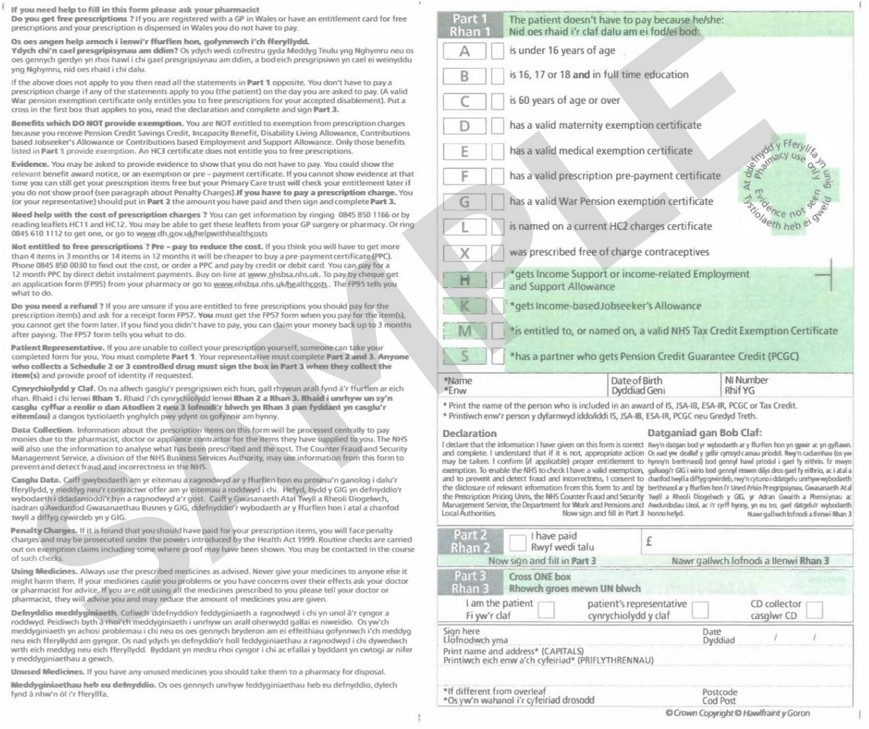
Below is an image of the back of the WP10SS
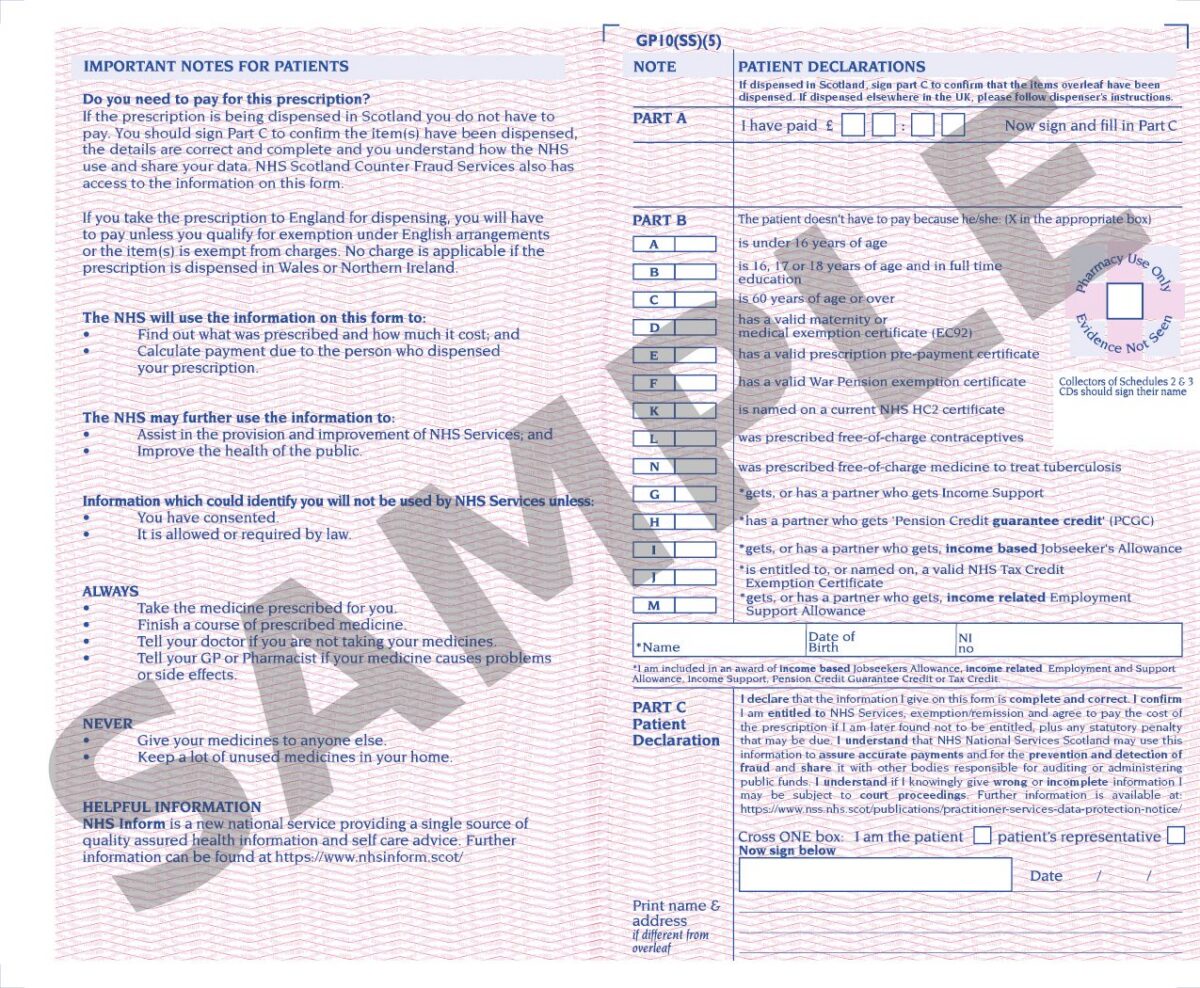
Below is an image of the back of the GP10SS
Dispensing private controlled drug prescriptions
Private prescriptions for Schedule 2 or 3 Controlled drugs issued in the devolved nations can be dispensed by a pharmacy based in England. Private prescriptions for Schedule 2 and 3 Controlled drugs must be issued on the correct prescription form to be valid. In Wales, the required form is WP10PCD or WP10PCDSS, in Scotland the PPCD (1) form must be used, and the PCD1 form must be used in Northern Ireland.
The private prescription forms should be submitted in the same way FP10PCD forms are submitted in the end of month prescription bundle. For more information on submission requirements, please see Community Pharmacy England’s Dispensing Controlled Drugs webpage.
Prescription forms
Instalment prescriptions in Wales are issued on WP10MDA or WP10HP(AD) prescription forms. Instalment dispensing has no specific form type in Northern Ireland or Scotland.
- In Northern Ireland, instalments may be prescribed on HS21, HS21N, HS21X, SP1 or SP2 forms
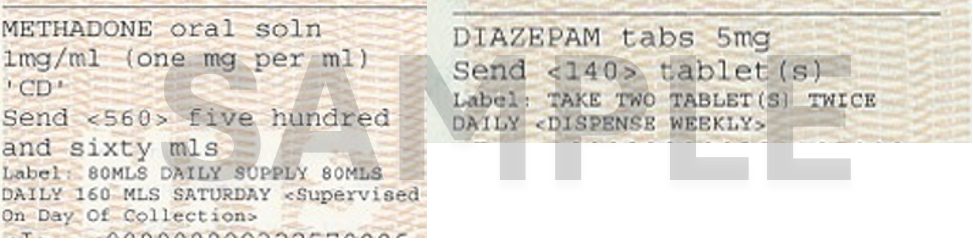
- Scottish instalment prescriptions can be prescribed on GP10SS or HBP(A) forms.
Below is an example of how an instalment prescription is issued on a GP10SS prescription form:
Pharmacy teams must endorse the quantity dispensed and the number of instalments dispensed. Instalment prescriptions should be submitted in the end of month bundle as FP10MDA forms are submitted. Please note: packaged dose fees are also payable on instalment forms from the devolved nations. For more information on instalment prescriptions, including endorsement requirements, please visit our Dispensing Controlled Drugs page.
Prescriptions issued in Northern Ireland do not attract prescription charges if dispensed in England, Scotland or Wales.
Prescriptions issued in Scotland or Wales and dispensed in England are subject to English prescription charge rules. The patient must either pay the applicable English prescription charge or be in possession of a valid exemption from paying prescription charges. Where prescription charges are paid, patients may request a refund claim form if they are unsure of their charge status. Pharmacy teams should provide an FP57 receipt at the time the charge is paid by the patient, provided the patient believes they are exempt under an English exemption category.
English FP10 paper prescriptions dispensed in Scotland or Wales also attract prescription charges if the patient does not hold a valid charge exemption reason. Patients who live in Scotland or Wales who are registered at a GP surgery in England may be able to apply for an entitlement card which provides exemption from prescription charges at Scottish and Welsh pharmacies.
The table below summarises the charge rules for prescriptions issued and dispensed in each devolved nation:
| Prescription | Dispensed in England | Dispensed in Scotland | Dispensed in Wales | Dispensed in Northern Ireland |
| English prescription | Prescription charges apply unless the patient holds a valid entitlement card or is exempt from prescription charges via the English exemption rules | Prescription charges apply unless the patient holds a valid entitlement card or is exempt from prescription charges via the English exemption rules | No prescription charges apply | |
| Scottish prescription | Collect prescription charges according to English rules | No prescription charges apply | No prescription charges apply | |
| Welsh prescription | Collect prescription charges according to English rules | No prescription charges apply | No prescription charges apply | |
| Northern Ireland prescription | No prescription charges apply | No prescription charges apply | No prescription charges apply |
English pharmacies dispensing cross-border prescriptions should:
- Check the prescription form is valid and that the prescription can legally be dispensed in England.
- Dispense the prescription following usual prescription processing procedures, ensuring all required endorsements are included.
- Apply the correct charge or exemption status:
- Welsh and Scottish prescriptions dispensed in England: patients should pay for their prescriptions unless they are exempt under the English charge exemption rules. The appropriate paid/exempt declaration and signature should be applied to the prescription.
- Northern Irish prescriptions dispensed in England: no prescription charges apply.
- Ensure EPS claim messages are submitted on time for any Welsh EPS prescriptions dispensed in England.
- Sort paper prescriptions for end-of-month submission in line with the NHSBSA’s usual prescription sorting requirements.
- Complete and submit the FP34C declaration form through Manage Your Service (MYS) and dispatch the paper prescription bundle, including the Account Identifier Document, to NHSBSA by the 5th of the month (or by the 6th if one or more bank holidays occurs in the first 5 days of the month).
Pharmacy teams can refer to our Sorting prescriptions for end of month submission and End of month prescription and FP34C submission process webpages for further guidance.
If a patient from Northern Ireland, Scotland or Wales requires an emergency supply of a prescription-only medicine (POM) and is unable to obtain a prescription from their prescriber, an emergency supply may be possible.
The pharmacist must assess whether the legal requirements for an emergency supply are met in line with the Human Medicines Regulations 2012, including whether there is an immediate need and whether it is impracticable for the patient to obtain a prescription without undue delay. The pharmacist must also be satisfied that the requested medicine was previously prescribed for the patient and use professional judgement to determine the appropriate quantity to supply.
Emergency supply arrangements do not remove the need to follow the usual legal requirements, record-keeping requirements and professional judgement. Pharmacy teams should refer the patient to the prescriber, NHS 111 or another appropriate service where an emergency supply is not appropriate.
FAQs
Q. Can patients who do not live in England, such as temporary visitors or tourists, obtain an urgent supply of a medicine or appliance via Pharmacy First?
An urgent supply via the service is available to anyone in England who has recently been treated by the NHS and has received an NHS prescription for the item that is being requested. Patients treated in Wales, Scotland & Northern Ireland would be eligible, as would patients with prescriptions generated from other NHS organisations, for example, acute trusts.
For overseas patients visiting from countries outside the UK, an urgent supply under the service could be made for a patient who was receiving ongoing care under the NHS with an NHS prescription and needed an urgent supply of medicines to continue treatment. For example, this might include a patient who was recently discharged from an NHS hospital or who were treated on the NHS and had received an NHS prescription under a reciprocal healthcare arrangement.
Q. Can English pharmacies dispense NHS prescriptions issued in the Isle of Man?
A. Yes, English pharmacies can dispense NHS prescriptions issued in the Isle of Man. The English prescription charge rules apply to patients who present a prescription issued in the Isle of Man for dispensing in England. There are no additional submission requirements; paper prescriptions for end-of-month submission should be sorted in line with the NHSBSA’s usual prescription sorting requirements.
Q. Can English pharmacies dispense NHS prescriptions issued in The Channel Islands?
A. No, English pharmacies cannot dispense prescriptions issued in Guernsey or Jersey at NHS expense. Prescriptions issued in Guernsey or Jersey that are dispensed in England are not eligible for NHS reimbursement and will therefore not be paid by the NHSBSA.
Useful links
Prescription submission
Sorting prescriptions for end-of-month submission
Prescription form validity
NHSBSA: Submitting prescriptions
NHSBSA: Prescription charges guidance
NHS Digital: Electronic Prescription Service
For more information on this topic please email comms.team@cpe.org.uk