Category C
Published on: 11th November 2026 | Updated on: 11th November 2026
There are 4 categories of drugs listed in Part VIIIA of the Drug Tariff, referred to by the letters A, C, H and M. Drugs included in Category C are licensed medicines that are not generally available as generics or do not meet the qualifying entry criteria for Category A, H or M.
This page explains the price-setting and reimbursement arrangements for drugs listed in Category C, including the relevant Drug Tariff provisions that apply to this category.
If a medicine listed in Part VIIIA of the Drug Tariff is prescribed generically, a pharmacy owner in England will be reimbursed by the NHS for it according to the indicative price listed in Part VIIIA. Reimbursement prices for generically prescribed drugs listed in Category C are based on the NHS list prices of agreed reference products (brand, manufacturer or supplier name) as displayed in NHS dictionary of medicines and devices (dm+d) and are subject to the price change mechanism. If a Category C drug is prescribed by brand, reimbursement is based on its NHS list price as published in the dm+d.
Majority of Category C drugs are branded medicines without competition (patent protected), with reimbursement based on the brand originator’s NHS list price as published in dm+d. Drugs available as generics may also be listed in Category C – these include medicines that do not meet either Category A or M entry criteria. For most Category C products, the reference product (brand, manufacturer or supplier name) is displayed alongside the generic drug description listed in Part VIIIA of the Drug Tariff.
The image below shows examples of drugs listed in Category C, showing prices for the listed pack sizes based on specific reference products.
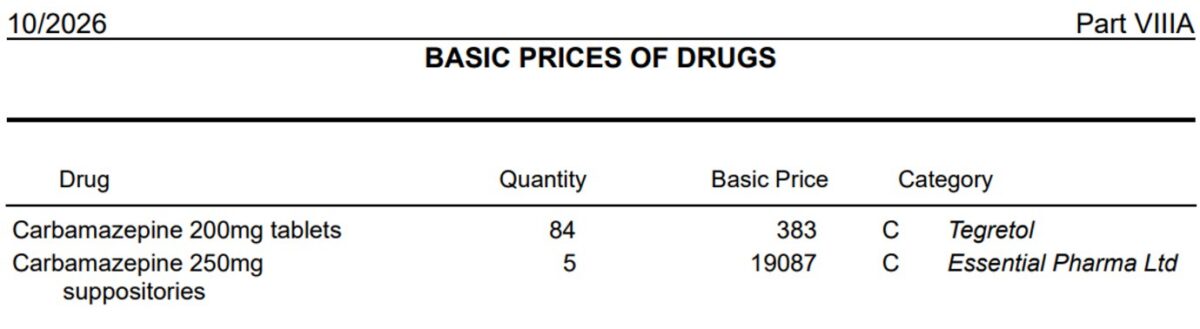
Image from October 2026 Drug Tariff
In the example above, Carbamazepine 200mg tablets (84) has the brand Tegretol® listed as its reference product with a NHS dm+d list price of £3.83 (accurate as of October 2026).
For Carbamazepine 250mg suppositories (5), its manufacturer, Essential Pharma Ltd, is listed as the reference product with a NHS dm+d list price of £190.87 (accurate as of October 2026).
Certain Category C drugs available in more than one pack size may have a different reference product displayed against each pack size. In some cases, different pack sizes of the same drug in Category C may have reference products manufactured by different suppliers. For example, Salbutamol 200micrograms/dose dry powder inhaler is listed in two pack sizes in the Drug Tariff: the 60 dose inhaler has Ventolin® Accuhaler as the reference product with a reimbursement price of £3.60 and the 200 dose size has Easyhaler® Salbutamol listed as its reference product with a reimbursement price of £8.12 (accurate as of October 2026).

Image from October 2026 Drug Tariff
Other factors that may influence the selection of pack sizes and corresponding reference products in Category C include special container status, primary care availability and differences in licensed indications or uses between different brands of the same drug.
Some Category C drugs are available from multiple suppliers either as brands and/or generics (including branded generics) i.e. there is competition between suppliers. For these drugs, DHSC and Community Pharmacy England will agree on a suitable reference product that determines the reimbursement prices of Category C drugs prescribed generically. For certain Category C drugs, no reference product is displayed against the Drug Tariff listing for example, where two or more suppliers of a drug share the same NHS list price on dm+d, as shown in the image below.

Image from October 2026 Drug Tariff
Please note: in March 2026, a new Drug Tariff Part VIIIA category, Category H, was introduced to include a subset of drugs previously listed in Category C with multiple brands and/or suppliers. Unlike Category C, reimbursement prices for Category H products are based on market data rather than the NHS list price of a specific reference product. The reimbursement prices of medicines listed Category H are calculated using actual purchase, sales and volume information obtained by the Department of Health and Social Care (DHSC) under the Health Service Products (Provision and Disclosure of Information) Regulations 2018. Further information, including products that have moved to Category H, is available on our Category H webpage.
Reimbursement prices for Category C drugs are based on the NHS list prices held in the NHS dictionary of medicines and devices (dm+d). As the Drug Tariff is updated monthly, it will not reflect any recent list price changes effected by suppliers. Therefore, the published basic prices for Category C drugs in the Drug Tariff are indicative, as they may not always reflect the actual reimbursement prices paid to pharmacy owners in that month.
To determine the timing of reimbursement of Category C drugs affected by list price changes, a price change mechanism or timetable was put in place by DHSC to allow the reimbursement prices of certain drugs to catch up with any changes to their NHS list prices. The impact of the price change timetable on reimbursement is outlined below:
Following a change to the NHS list price of a product, the corresponding Drug Tariff and/or reimbursement price adjustment is influenced by two key factors:
- The type of product i.e. brand (proprietary) or generic (non-proprietary); and
- The effective price change date (i.e. the date the list price is updated by the supplier) – whether this was on or before the 8th of the month or after the 8th of the month
Generics with list price changes
- If the list price is updated on or before the 8th of the month, the new price would apply to reimbursement in the same month
- If the list price is updated after the 8th of the month, the new price would apply to reimbursement from the following month
Brands with list price changes
- If the list price is updated on or before the 8th of the month, the new price would apply to reimbursement the following month
- If the list price is updated after the 8th of the month, the new price would apply to reimbursement from the month following the next
The table below illustrates how changes to NHS list prices are applied to reimbursement of drugs listed in Category C with branded and generic reference products and when the Drug Tariff is updated to reflect any list price changes:
| List price change | On or before the 8th of the month | After the 8th of the month |
| Generic drug |
The new list price would apply to reimbursement in the same month For example, if the list price of a generic reference product was updated on 1 August, the new list price would apply to reimbursement of prescriptions dispensed in August. The Category C reimbursement price listed in the Drug Tariff would be updated in the September Drug Tariff* |
The new list price would apply to reimbursement the following month For example, if the list price of the generic reference product was updated on 10 August, the new list price would apply to reimbursement of prescriptions dispensed from September onwards. The Category C reimbursement price listed in the Drug Tariff would be updated in the September Drug Tariff or October Drug Tariff * |
| Branded (proprietary) drug |
The new list price would apply to reimbursement the following month. For example, if the list price of the brand reference product was updated on 1 August, the new list price would apply to reimbursement of prescriptions dispensed from September. The Category C reimbursement price listed in the Drug Tariff would be updated in the September Drug Tariff*. |
The new list price would apply to reimbursement the month following the next. For example, a price change effective on 10 August would apply to reimbursement of prescriptions dispensed from October onwards. The Category C reimbursement price listed in the Drug Tariff would be updated in the October Drug Tariff*. |
*The Drug Tariff is published monthly, three working days before the end of the preceding month. Where the NHS list price of a Category C reference product changes after publication, the revised price may not be reflected in the published Drug Tariff for that month. However, reimbursement will be based on the revised price from the applicable month, in accordance with the current price change timetable.
The timing of a list price change under the current price change timetable can result in pharmacies being reimbursed based on the previous NHS list price with pharmacy owners having to wait one (or in some cases two months) before the list price before the list price change is reflected in the Drug Tariff and applied to reimbursement. For drugs with list price increases, any delays in reimbursement prices catching up can lead to pharmacies dispensing at a loss. The impact is more significant for products with large list price increases or drugs with a high dispensing volume. More information about the price change timetable can be found on the Price change mechanism webpage.
Under the NHS Act 2006, the Department of Health and Social Care (DHSC) is required to consult Community Pharmacy England before making changes to Part VIII of the Drug Tariff.
Unlike Category A, H and M, which are updated on a quarterly cycle, Category C is updated monthly. Each month, DHSC will share its proposals for Part VIII, including new product additions and deletions. Drugs in Category C can also be moved to a different Part VIIIA drug category (or vice versa), subject to meeting relevant entry criteria. Other changes to Category C may include amendments to reference products if an existing reference product has been discontinued or is no longer available. In some cases, a drug may be proposed for deletion from Category C if no suitable alternative exists.
Community Pharmacy England will assess each proposal against the agreed criteria for the relevant drug category and carry out a series of checks (for example, product availability, pricing, discount availability, special container status, etc.) to help inform our response. Agreed changes are published in the Drug Tariff Preface section, with advance notice where applicable. At the end of each month, Community Pharmacy England publishes a Drug Tariff Watch resource to provide pharmacy teams with an overview of the upcoming changes to Part VIII of the Drug Tariff.
- Price concessions – In any given month, if a pharmacy owner is unable to purchase a Category C drug at or below the published Drug Tariff price, a price concession may be requested through the usual process. We encourage pharmacies to report any problems obtaining a Part VIII product at or below the listed Drug Tariff price, using our online feedback form.
- Discount deduction – Where a Category C drug is prescribed generically, a discount deduction rate of 5% is applied to the reimbursement price unless the product is a Discount Not Deducted (DND) item (either Group or Individual Item listed in Part II of the Drug Tariff). Please note: All drugs granted concessionary prices are exempt from discount deduction for the month in which the price concession applies. Visit our Discount Deduction webpage for further information.
- Pack size endorsement – Where a Category C drug is listed in the Drug Tariff with more than one pack size, endorsement of pack size supplied is required.
- Out-of-pocket expenses – Subject to meeting relevant criteria, out-of-pocket expenses (over 50p) can be claimed for drugs listed in Category C by endorsing ‘XP’ (EPS) or ‘OOP’ (Paper) along with the amount and reason for claiming. To claim for out-of-pocket expenses, the circumstances must be exceptional, the drug must not be frequently supplied by the pharmacy, and the pharmacist must have taken all reasonable steps to avoid incurring out-of-pocket expenses. It’s important to note that all three conditions above must be satisfied before an out-of-pocket expenses claim is made. Further information on out-of-pocket expenses can be found here.
- Broken Bulk – Broken Bulk may be claimed for Category C drugs, except for those classed as special containers or where Original Pack Dispensing +/- 10% rules have been utilised. Pharmacy owners should only claim Broken Bulk (by endorsing ‘BB’ and the pack size used) where it is unlikely that the residual balance will be dispensed within six months of splitting the pack. Further information can be found on our Broken Bulk
| Category A | Category C | Category M | Category H | |
| Products included | Readily available licensed generic medicines (low volume) | Not generally available as a generic (or does not meet qualifying criteria for Category A or M) | Readily available licensed generic medicines (high volume) | Drugs available from multiple suppliers (previously listed in Category C) |
| Price-setting approach | Based on market data obtained under the Health Service Products (Provision and Disclosure of Information) Regulations 2018. | Based on the list price of a particular brand or manufacturer. | Based on market data obtained under the Health Service Products (Provision and Disclosure of Information) Regulations 2018. | Based on market data obtained under the Health Service Products (Provision and Disclosure of Information) Regulations 2018. |
| Frequency of price changes | Quarterly (January, April, July and October) | Monthly – subject to the price change mechanism | Quarterly (January, April, July and October) | Quarterly (March, June, September and December) |
| Discount deduction rate if generically prescribed (unless DND) | 20% | 5% | 20% | 5% |
| Broken Bulk eligibility (excluding special containers) | If necessary for products with smallest listed pack size of £50 or over | Yes | If necessary for products with smallest listed pack size of £50 or over | Yes |
| Out-of-pocket expenses eligibility | No | Yes | No | Yes |
Pharmacy teams are encouraged to report any pricing issues affecting any Part VIII drug, including those listed in Category C, to Community Pharmacy England’s Dispensing and Supply Team using the online feedback form on our website. Community Pharmacy England will investigate, and if a pricing issue is identified, we will seek a price concession or a retrospective price adjustment, accordingly.
Occasionally, the price of a reference product in the Drug Tariff may be incorrect or out of date if a manufacturer has not updated Pharmacy teams are also encouraged to report instances of wholesalers selling branded medicines (for NHS use) above their agreed maximum NHS list prices as published on dm+d. Community Pharmacy England will share these reports with DHSC’s Branded Medicines team for further investigation.
Q. Why is there no reference product displayed against certain Category C drugs listed in Part VIIIA?
A. Every drug in Category C has an agreed reference product used to determine its reimbursement price. However, for some Category C drugs, no reference product is displayed in the Drug Tariff. This does not mean that a reference product does not exist for these drugs; it is simply that the name of the brand/manufacturer has been omitted because multiple suppliers/manufacturers share the same list price on dm+d.
Q. If a Category C drug is available from multiple suppliers, am I expected to supply the specific brand or manufacturer’s product listed as the reference product when dispensing a generically written prescription for the drug?
A. No. Where a Category C product is available from more than one supplier, pharmacy teams are not expected to dispense the reference product listed in the Drug Tariff. The reference product is used to determine the Category C reimbursement price and is not intended to determine which product needs to be supplied against a generically written prescription. Pharmacy teams can dispense any equivalent licensed product, provided it fulfils the order on the prescription and meets the needs of the patient.
Q. If a Category C drug is available from multiple suppliers, will the pharmacy be reimbursed based on their endorsement if an alternative brand or manufacturer’s product (not the reference product) is supplied against a generically written prescription?
A. No. Reimbursement prices for generically prescribed drugs listed in Category C are always based on the NHS list prices of agreed reference products (brand, manufacturer or supplier name) as displayed in NHS dictionary of medicines and devices (dm+d) and is subject to the price change mechanism. Pharmacy owners will not be paid based on their endorsement if an alternative brand or manufacturer’s product to the current Category C reference product is supplied against a generically written prescription. The only endorsement required is the pack size supplied if a Category C drug has more than one pack size listed in the Drug Tariff.
Q. I am unable to obtain the Category C reference product at or below the price published in the Drug Tariff. What should I do?
A. Pharmacy teams are encouraged to report any pricing issues affecting any Part VIII drug, including those listed in Category C, to Community Pharmacy England’s Dispensing and Supply Team using the online feedback form on our website. Community Pharmacy England will investigate further, and if a pricing issue is identified, we will seek a price concession or a retrospective price adjustment, accordingly. Please note that the timing of a list price change under the current price change timetable can result in pharmacies being reimbursed based on the previous NHS list price, with pharmacy owners having to wait one (or in some cases two months) before the list price change is reflected in the Drug Tariff and applied to reimbursement.
Related Resources
How the price change mechanism works
Funding and Reimbursement short: Understanding Part VIII of the Drug Tariff
For more information on this topic please email comms.team@cpe.org.uk