Out-of-pocket expenses
Published on: 3rd May 2013 | Updated on: 18th February 2026
The out-of-pocket expenses endorsement (‘OOP’ or ‘XP’) enables community pharmacy owners to claim certain expenses incurred when obtaining eligible drugs or appliances for dispensing against NHS prescriptions. On this page, we explain what product categories are eligible for out-of-pocket expense claims, the circumstances under which a claim can be made, and provide guidance on recording and monitoring any claims submitted for payment.
Drug Tariff requirements for out-of-pocket expense claims
The requirements for claiming out-of-pocket expenses are set out in Part II, Clause 12 of the Drug Tariff. These rules allow pharmacy owners to claim certain expenses (where these exceed 50 pence per item) incurred when obtaining eligible drugs or appliances for dispensing against NHS prescriptions.
Before an out-of-pocket expense claim is made, all three of the following conditions must be met:
- The circumstances giving rise to the claim must be deemed exceptional.
- The claim must relate to an item that is not required to be frequently supplied by the pharmacy owner.
- The pharmacy owner must have taken all reasonable steps to avoid incurring out-of-pocket expenses.
It’s important to note that these are cumulative requirements, meaning all three conditions must be satisfied before an out-of-pocket expense claim can be considered.
Eligibility
Out-of-pocket expenses can only be claimed for certain product categories, as set out below:
| OOP expenses can be claimed for: | OOP expenses cannot be claimed for: |

|

|
* An exception to this is Cefuroxime 5% preservative free eye drops for which a fixed out-of-pocket expense payment of £50 will be automatically applied to NHS prescriptions for Cefuroxime 5% eye drops preservative free. See below for more information.
** The ‘SP’ fixed fee for dispensing/handling unlicensed specials and imports is a separate arrangement (see Part IIIA of the Drug Tariff). More information can be found here.
Only actual costs incurred during the process of obtaining specific items to fulfil specific prescriptions can be claimed. This includes costs such as: It is important that any charges incurred can be linked back to an order for an eligible product on a specific prescription. VAT can be included in an out-of-pocket claim as long as the normal criteria for claiming expenses are met. VAT can only be claimed on expenses incurred in obtaining the product, such as postage or handling charges. It cannot be claimed on the cost of the product itself.
From 1st March 2024, an additional fixed out-of-pocket expense payment of £50 will be automatically applied to NHS prescriptions for Cefuroxime 5% eye drops preservative free (a non-Drug Tariff special). Due to unique temperature-controlled transport and storage requirements for Cefuroxime 5% eye drops preservative free, a £50 out-of-pocket expense fee was agreed to cover costs of delivery and handling charges applied by suppliers. This is the only unlicensed medicine/special where an additional out-of-pocket expense of £50 is automatically paid by the NHSBSA. No additional endorsements are required to claim this fixed £50 out-of-pocket expense payment i.e. the ‘XP’ or ‘OOP’ endorsement is not required. This additional £50 payment will only apply to NHS prescriptions for Cefuroxime 5% eye drops preservative free. Other applicable fees such as the £20 fixed fee specials handling fee (claimed by endorsing ‘SP’) will continue to be paid in addition to the reimbursement based on the invoice price endorsement. The image below shows how a prescription should be endorsed and in this example the £20 ‘SP’ fee and the additional £50 out-of-pocket fixed fee would be paid. For more information see here. Out-of-pocket expense claims must exceed 50 pence per item. In practice, this means that a claim must be at least 51 pence per item to be accepted. Once the minimum threshold has been met, the full amount of the eligible out-of-pocket expense will be paid. There is no maximum threshold for an individual out-of-pocket expense claim. Any claim must reflect the actual costs incurred in obtaining the specific eligible item to dispense against an NHS prescription. Costs must be item-specific and must not be estimated, averaged, or rounded.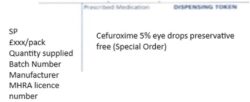
To ensure payment, contractors must endorse:
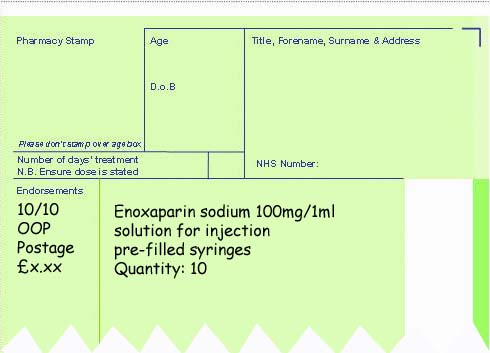
FP10 paper prescription forms endorsed ‘OOP’ or ‘XP’ for out-of-pocket expense claims must be separated from other prescriptions and placed in the relevant exempt/paid red separator before submission to the NHS Business Services Authority (NHSBSA). This helps ensure that prescriptions with out-of-pocket expense claims are correctly identified and processed. For more information see our Dispensing Factsheet: Prescription sorting requirements using red separators. Pharmacy owners are not required to submit evidence of out-of-pocket expenses to the NHSBSA. However, receipts, invoices or supplier correspondence should be retained in the pharmacy in case of any audit or query.
Record keeping Pharmacy owners are advised to keep a record (or log) of all out-of-pocket expense claims submitted, to support reconciliation against their FP34 Schedule of Payments and Prescription Item Reports (PIRs). Pharmacy owners are not required to submit any evidence of out-of-pocket expenses to the NHS Business Services Authority (NHSBSA) with their prescription submissions. However, it is good practice to retain receipts, invoices and supplier correspondence relating to out-of-pocket expense claims in case of any query about payment or where a claim needs to be checked or corrected. It is also good practice to retain brief notes to support why an out-of-pocket expense claim was appropriate, including how the three cumulative Drug Tariff conditions were met (for example, why the circumstances were genuinely exceptional and what reasonable steps were taken to avoid incurring the expense). For more information about post-payment checks on out-of-pocket expense claims and what evidence pharmacy teams may be asked to provide, see the section ‘Provider assurance activity of out-of-pocket expense claims’ below. Monitoring claims for reconciliation Regularly reviewing both the FP34 Schedule of Payments and the Prescription Item Report (PIR) can help pharmacy owners: FP34 Schedule of Payments The total value of items with out-of-pocket expense claims, as priced by the NHS Business Services Authority (NHSBSA), is included within the ‘Drugs and appliance costs’ section of the FP34 Schedule of Payments. This allows pharmacy owners to monitor the overall value of out-of-pocket expense claims paid in a particular dispensing month. Prescription Item Reports (PIR) For more detailed checking, pharmacy owners can use the Prescription Item Report (PIR). The PIR provides an item-level breakdown of reimbursement and remuneration for each product submitted for payment, including details of any endorsements applied, such as ‘OOP’ or ‘XP’. This can help pharmacy teams confirm that individual out-of-pocket expense claims have been processed as expected by the NHSBSA. More information see our Community Pharmacy England briefing factsheet: Prescription Item Reports (PIRs).
NHSBSA, on behalf of NHS England, use the post-payment verification (PPV) process to assure the NHS that the activity pharmacies deliver under the Community Pharmacy Contractual Framework has been performed in line with the regulations. NHSBSA do this by requesting evidence to substantiate claims. Therefore, any evidence in support of out-of-pocket expense claims should be retained for post-payment verification exercises or to assist with any investigations. Retention periods Previous PPV activity outcomes Part of this guidance reinforces that not all costs incurred by pharmacies can be claimed under the out-of-pocket expenses provision. Some expenses, while incurred, may fall outside of the scope of the three cumulative conditions and therefore are not eligible for reimbursement. An example of costs that cannot be claimed under the out-of-pocket expense provision is wholesaler fuel surcharges, because they are applied monthly at the account level and cannot be linked to a specific product or order supplied against an NHS prescription.
There is no stated minimum length of time for retention of records for PPV activity on claims submitted for out-of-pocket expenses. For tax purposes, pharmacy owners are required to retain invoices for 6 years. Therefore, it would be advisable to retain all other evidence in support of out-of-pocket expense claims for a similar period of time.
NHSBSA has developed guidance to help support pharmacy owners with out-of-pocket expense claims and to highlight outcomes from the most recent PPV activity: NHS BSA Out of Pocket Expenses – Guidance for pharmacy contractors.
Individual out-of-pocket expenses are recharged to the prescriber’s Integrated Care Board (ICB) budget. This is to increase transparency around payment of these claims and to ensure that each ICB is accountable for the charges associated with prescribing within their locality.
Some suppliers levy charges where a minimum spend threshold has not been met. Where it is not possible to avoid incurring a minimum order surcharge, Community Pharmacy England’s view is that this could be claimed as an out-of-pocket expense, but only in exceptional circumstances. However, where a contractor can reasonably be expected to routinely order a range of low volume products from a wholesaler, in order to bring their value of purchases above the minimum threshold, our advice is that they should attempt to do this, as there is a substantial risk that routine orders would not satisfy the description of ‘exceptional circumstances’. It is important that contractors have clear, auditable procurement policies in place in order to demonstrate that minimum order surcharges or delivery charges are avoided where possible.
FAQs
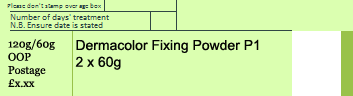 Yes, in exceptional circumstances where the pharmacy has been unable to obtain the product without incurring additional expenses, this item is eligible for 0ut-of-pocket expense claims (see picture opposite).
Products eligible for out-of-pocket expense claims are as follows:
- Drugs in Part VIIIA Category C and H
- Readily available medicinal products outside of Part VIIIA (including ACBS products)
- Appliances in Part IXB
- Appliances in Part IXC
Products listed in Part IXA and IXR of the Drug Tariff are not eligible for out-of-pocket expense claims.
In order to list a product in the Drug Tariff, manufacturers must declare that their product “will be readily available to dispensing contractors either through the normal wholesale network or on equivalent terms” so if a product is unavailable without additional charges from either the manufacturer or the wholesale network, the manufacturer may not be meeting the requirements for their product to remain listed in the Tariff. Please report any products in this scenario to the Community Pharmacy England Dispensing and Supply Team (0203 1220 810 or email comms.team@cpe.org.uk) who will investigate and, where necessary, escalate the problem to NHS Prescription Services.
As it can take time to reach a resolution with appliance manufacturers, Community Pharmacy England recommends considering the following points prior to contacting us to report the problem:
- Where a Part IXA appliance is not available from your usual wholesaler without additional charges, contact the manufacturer to find out whom they supply to and whether it is possible to obtain the product directly without charge.
- Alternatively, discuss the problem with the prescriber and consider requesting a new prescription for an equivalent product which is available without additional charges.
- As a last resort, NHS pharmacy contractors are not contractually obliged to supply appliances that would not normally be supplied in the course of their business. Therefore, if a contractor is faced with making a financial loss through dispensing an appliance, they may choose not to dispense it.
Reimbursement of charges related to the sourcing of unlicensed specials and imports falls under the arrangements for payment of specials and imported unlicensed medicines introduced in November 2011 (Part VIIIB of the Drug Tariff).
The ‘OOP’ or ‘XP’ endorsement cannot be used on prescriptions for unlicensed specials and imports. Instead, contractors are entitled to claim the fixed fee (currently £20), which is to cover the additional costs associated with procuring both Part VIIIB and non-Part VIIIB listed specials. The fee is paid when the prescription has been endorsed with ‘SP’ (or ‘ED’ for extemporaneously dispensing the item).
No, staff costs should not be claimed as an out of pocket expense. A current issue is the branded medicine supply problems. Community pharmacy teams work extremely hard to ensure patients get the medicines they need; where shortages occur this often involves spending additional hours sourcing required products from wholesalers and manufacturers. The funding settlement recognises and allows for costs associated with this time and resource.
As wholesaler fuel surcharges are levied once a month to customer accounts, this does not relate to a specific product or order, and therefore it is not possible for pharmacy contractors to claim this fee back under the current arrangements for out-of-pocket expenses. Community Pharmacy England has had discussions with the Department of Health and Social Care on this issue. We are working to ensure that fuel surcharges are considered in the general funding arrangements.
Yes, where in exceptional circumstances, products need to be obtained from another pharmacy to support patient care, the expenses incurred can be claimed. This may include taxi fares or postage and packaging.
Related resources
REF: Drug Tariff Part II, Clause 12
NHS BSA Out of Pocket Expenses – Guidance for pharmacy contractors
Unlicensed specials and imports
For more information on this topic please email comms.team@cpe.org.uk