Expensive Items
Published on: 1st July 2021 | Updated on: 5th December 2025
An expensive item is any item dispensed on an NHS prescription with a total net ingredient cost (NIC) of £100 or more. This applies whether the cost arises from supplying a single pack or multiple packs of an item used to fulfil a prescription.
This page outlines what the expensive item fee is, how to submit FP10 paper prescriptions containing expensive items and how to check which items have been treated as expensive items.
Part IIIA of the Drug Tariff outlines the different professional fees pharmacy owners receive for dispensing prescriptions, including the expensive prescription fee. For every item with a net ingredient cost (NIC) of £100 or more, pharmacy owners receive a fee equal to 2% of the NIC which is calculated based on the total quantity of that individual item dispensed on the prescription form. This applies to both drugs and appliances.
The expensive prescription fee is automatically applied by the NHS Business Services Authority (NHSBSA); no additional endorsements are necessary to claim this fee. Please note that pharmacy owners must apply all other required dispenser endorsements as usual. Where required, the pack size and price must be endorsed so that the NHSBSA can identify any expensive items and apply the expensive prescription fee to these. For further information see Community Pharmacy England’s page on Endorsement guidance.
The expensive item fee is paid in the following circumstances:
- Products where reimbursement is based on the NHS list price that is greater than or equal to £100. For example, the NHS list price for Tirzepatide 15mg/0.6ml solution for injection (Mounjaro®) 2.4ml pre-filled disposable devices (1) has a list price over £100, making it an expensive item.
- Where the total NIC of the dispensed quantity is £100 or more. For example, Lisdexamfetamine 70mg capsules (Elvanse®) is reimbursed at £83.16 for a pack of 28 capsules (according to the December 2025 Drug Tariff). If a prescription orders two packs (56 capsules) the total NIC for this item works out to £166.32 which qualifies for the expensive prescription fee.
- Where a price concession granted for item results in a total NIC of £100 or more
- Where the pharmacist correctly applies the Original Pack Dispensing (OPD) +/-10% rules to a product taking its total NIC to £100 or more
- Where a larger quantity of a product supplied following special container rules increases the total NIC per item to £100 or more.
Paper prescriptions
Pharmacy teams must ensure all required dispenser endorsements are clearly applied to items prescribed on FP10 paper prescriptions before submission at the end of the month. The required endorsements may include the quantity dispensed, pack size, and pack price. Providing this information allows the NHSBSA to easily identify expensive items and apply the expensive item fee accordingly. FP10 paper prescriptions with expensive items must be placed in the relevant red separators in the prescription bundle for end of month submission to the NHSBSA. Prescription forms submitted in the red separator are subject to additional checks by the operators at the NHSBSA before payment is confirmed. For information on sorting prescriptions into red separators, see our Dispensing Factsheet: Prescription sorting requirements using red separators .
EPS prescriptions
There are no virtual red separators for electronic prescriptions as these are reimbursed based on information contained within the Electronic Reimbursement Endorsement Message (EREM) or Claim Notification (CN) message. There is no requirement to submit EPS tokens that have expensive items to the NHSBSA unless these are required for exemption checking purposes. For guidance see our Briefing factsheet: EPS token submission.
All EPS claims should be submitted in a timely manner to avoid any delays in payment. With electronic prescriptions, if an item is dispensed in one month but the corresponding EREM or CN message is submitted after the 5th of the following month, pharmacies will be reimbursed for the item based on the Drug Tariff relating to the month in which the claim is submitted for payment and not the actual dispensing month. Any delays in claiming payment can impact reimbursement for example, due to Drug Tariff price changes or if a price concession is granted in one month but not the next. For more information see our End of month prescription and FP34C submission process webpage and our briefing on Claiming for EPS prescriptions on time.
Community Pharmacy England recommends that pharmacy owners keep a monthly record of all expensive items dispensed and submitted for payment so that any claims can be reconciled against the list of expensive items published in the Schedule of Payments (see below for more information). Missing or incorrect payment(s) for expensive items can have a large impact on cashflow therefore it is important to keep a monthly record so this can be reconciled (see below). Some IT system suppliers may be able to assist pharmacy owners by generating monthly reports of expensive items dispensed and submitted for payment.
Pharmacy owners can expect to receive their monthly Schedule of Payments (and eSchedules) from the NHSBSA 5-working days before the payment date.
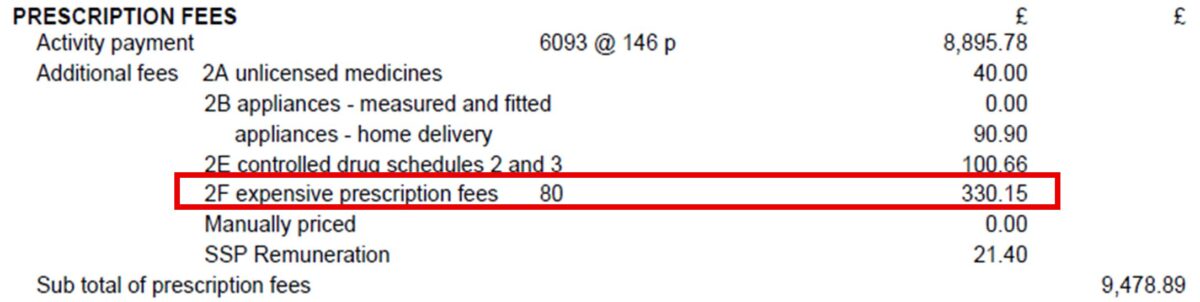
On page 1 of the Schedule of Payments, under the ‘Prescription fees’ section, the number of items for which the expensive prescription fee has been paid, and the total value of the fees paid are displayed. See example below.
Pharmacy owners can also view a breakdown of their expensive items within the Schedule of Payments. Please note that certain items which cost above £100 may not attract any expensive prescription fees if the total value of the prescribed quantity is below £100.
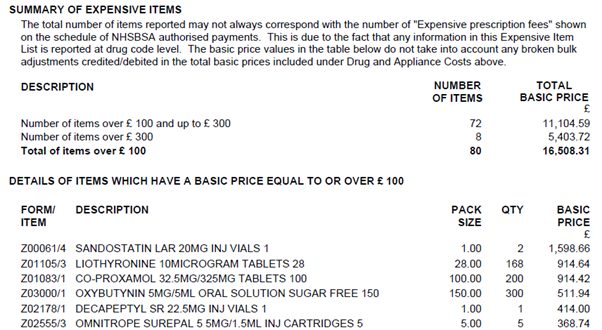
The “Summary of Expensive Items” section first provides a breakdown of the number of items by cost. It shows:
- Number of items over £100–£300,
- Number of items over £300 and
- Total of items over £100
An item level breakdown of expensive items supplied during the month is also shown under ‘Details of items which have a basic price equal to or over £100’ as shown below. Items are listed in descending order by value.
The summary of expensive items may include unlicensed specials, extemporaneously prepared items and items dispensed from multiple pack sizes with a combined value of £100 or more. Please note some expensive items may be listed as:
- ‘Exception handler unspecified item’ which indicates that the product is not listed in the NHS Dictionary of Medicines and Devices (dm+d).
- ‘Exception handler discount not deducted item’ which indicates that the product is not listed in NHS dm+d but is recognised as a product for which discount is not deducted.
The basic price does not take into account any Broken Bulk adjustments. Expensive items with Broken Bulk claims will only be itemised in the schedule if the NIC of the prescribed quantity exceeds £100. Items costing £100 or more over may not appear in the expensive item list if Broken Bulk has been claimed on it and the total value of the prescribed quantity is below £100. The reimbursement for any residual amount (unused quantity following the Broken bulk claim) is included in the ‘Drugs and Appliance cost’ section on page 1 of the schedule, either under the standard discount rate or the zero discount payment.
For prescriptions requesting ‘Assorted Flavours’, each flavour dispensed and endorsed is processed as a separate item. If the NIC of the individual flavour dispensed is below £100, the item will NOT be classed as an expensive even if the combined total cost of all flavours dispensed is £100 or more. However, if the NIC of the individual flavour endorsed is £100 or more than that particular item will appear in the list of expensive items in the Schedule of Payments. For more information see our Multiple flavours factsheet.
For more information on the Schedule of Payments, see our Understanding your FP34 Schedule of Payments webpage.
Pharmacy owners should be aware that fluctuations in the number or value of expensive items claimed each month can impact the pharmacy’s Average Item Value (AIV), which is used to calculate the pharmacy monthly advance payment.
If a pharmacy dispenses a large number of, or a high value expensive items in a particular month, the advance payment received may not cover the purchase costs of these items. Pharmacy owners will have to wait for their final reconciliation payment (received two months after the end of the dispensing month) to receive the actual payment for the expensive items dispensed. This can create cashflow issues for pharmacies if wholesalers require purchase invoices to be settled within 30 days from the end of month in which the order was placed. More information on the timing of payments can be found on our Understanding your Schedule of Payments page.
Note: The AIV is calculated using fee remuneration for prescriptions and the NIC of items supplied against prescriptions and the following Advanced services: Community Pharmacy Seasonal Influenza Vaccination Advanced Service (Adult), Pharmacy First and Pharmacy Contraception Service.
Pharmacy owners may request advance payments for high-cost drugs via their local Integrated Care Board (ICB) to help support cashflow.
Process for requesting an advance payment for high-cost items
Advance payments are authorised at the discretion of the local ICB, so pharmacy owners should contact their ICB directly to explore this option.
To authorise the payment, the ICB should:
- Request a local pharmacy payment spreadsheet template from the NHSBSA Contractor Payments Team: contractorpayments@nhsbsa.nhs.uk
- Populate the spreadsheet with contractor details, payment amount, the date the advance is to be paid, the recovery date (usually the month the item is being dispensed) and the relevant Local Payment Application (LPA) code (typically: ‘Advances for high cost – Rem’)
- Submit the completed spreadsheet to the NHSBSA Contractor Payments Team by the 7th of the month to ensure the claim is processed for that month: contractorpayments@nhsbsa.nhs.uk. If the claim is sent after the 7th, it will be processed for payment the following month.
The prescription for the high-cost item should be submitted to the NHSBSA as normal. Once the claim has been processed, the NHSBSA will issue the payment and recover the advance in accordance with the directions specified by the ICB.
The advance payment and recovery will appear in the Schedule of Payments under the section ‘Details of local amounts authorised by ICB’, with the LPA code used for tracking.
For further information see the following resources on the NHSBSA website:
Prescription Item Report (PIR)
For a detailed view of NHS payments each month, pharmacy owners can access their Prescription Item Reports (PIRs) via the NHSBSA Information Services Portal (ISP).
The PIR provides an item-level breakdown of payments for each product supplied against NHS prescriptions. By accessing the PIR, pharmacy owners can check for any reimbursement discrepancies related to expensive items as part of their reconciliation process. For further information on how to access the PIR, please see our Prescription item report (PIR) and Information Services Portal (ISP) page and Briefing factsheet: Prescription Item Reports (PIRs).
Column L of the PIR can be filtered to review items that have had the expensive item fee applied. These can then be reconciled with the pharmacy owner’s records of expensive items dispensed that month. The NHSBSA have also published a guide to understanding the PIR, under the ‘Understanding your prescription item report’ tab: Payment information section of the NHSBSA website.
Requesting a prescription recheck
After reviewing the monthly Schedule of Payments and/or the PIR, if any payment discrepancies (missing or incorrect payments) are identified, pharmacy owners can contact the NHSBSA at contractorpayments@nhsbsa.nhs.uk. They can also submit a request to the NHSBSA to carry out a prescription recheck of a specific month’s prescription bundle. Further details on how to request a recheck are available on our Prescription Rechecks webpage.
Related Resources
Dispensing factsheet: Expensive Items
Community Pharmacy West Yorkshire: Quick Dose: Knowledge Capsule – Back to Basics: Expensive Items
Understanding your FP34 Schedule of Payments
End of month prescription and FP34C submission process
Sorting prescriptions for end of month submission
Dispensing Factsheet: Prescription sorting requirements using red separators
For more information on this topic please email comms.team@cpe.org.uk