Healthy Living Pharmacies
Published on: 2nd August 2013 | Updated on: 23rd February 2026
The Healthy Living Pharmacy (HLP) framework aims to achieve a consistent provision of a broad range of health promotion interventions through community pharmacies to meet local need, improving the health and wellbeing of the local population and helping to reduce health inequalities.
Pharmacy owners were required to become a HLP in 2020/21 as agreed in the Community Pharmacy Contractual Framework: 2019-2024; this reflected the priority attached to public health and prevention work.
On 20th October 2020, NHS regulations were laid to introduce changes to the Terms of Service for pharmacy owners, which included HLP requirements, with supplementary information on the details being included in guidance on the regulations, which were published by NHS England.
Pharmacy owners had to ensure they were compliant with the HLP requirements from 1st January 2021, and the Distance Selling Pharmacy (DSP) website requirements had to be complied with from 1st April 2021.
Click on a heading below for more information
The HLP concept was developed in Portsmouth in 2009 with support from the Department of Health (DH), the Director of Public Health and the Local Pharmaceutical Committee following the publication of the 2008 White Paper, Pharmacy in England: building on strengths, delivering the future.
The White Paper described a vision to develop community pharmacies from being suppliers of medicines to become Healthy Living Centres providing self-care advice and treatment for common ailments and healthy lifestyle interventions, in addition to providing the safe supply and use of prescribed medicines.
The HLP framework was launched in September 2010 and Portsmouth HLPs delivered positive interim results. In March 2011, the national pharmacy bodies started working with DH to launch the HLP pathfinder programme, which resulted in an evaluation being published in April 2013. Following this, Public Health England (PHE) adopted the concept and supported the roll out in pharmacies across the country.
In 2016, PHE moved from a commissioner-led to a profession-led, self-assessment process for the attainment of HLP Level 1 status, which included the development of the PHE Quality Criteria. The PHE Quality Criteria underpinned the HLP enablers and set out the criteria that community pharmacies needed to meet to attain HLP Level 1 status.
Following this, NHS England introduced the achievement of HLP Level 1 status, as set out in the PHE Quality Criteria, as a criterion for payment under the Pharmacy Quality Scheme (previously known as the Quality Payments Scheme) for 2017/18.
Collectively, these initiatives introduced greater consistency in the delivery of public health interventions.
HLP is an organisational development framework underpinned by three enablers of:
- Workforce development – A skilled team to pro-actively support and promote behaviour change and improve health and wellbeing, including a qualified Health Champion who has undertaken the Royal Society for Public Health (RSPH) Level 2 Award ‘Understanding Health Improvement’, and a team member who has undertaken leadership training;
- Engagement – Local stakeholder engagement with other health and care professionals (especially general practice), community services, local authorities and members of the public; and
- Environment (premises requirements) – Premises that facilitate health promoting interventions with a dedicated health promotion zone.
The adoption of HLPs marked a significant development for community pharmacy and its contribution to health promoting interventions.
The HLP framework aims to improve people’s health and help reduce health inequalities. It provides a mechanism for community pharmacy teams to utilise their local insight and experience in the delivery of high-quality health promoting initiatives. By requiring pharmacy owners to have trained Health Champions on site who pro-actively engage in local community outreach within and outside the pharmacy, HLPs have cemented the idea that every interaction in the pharmacy and the community is an opportunity for a health promoting intervention.
The HLP framework is primarily about adopting a change in culture and ethos within the whole pharmacy team. The HLP framework means community pharmacies can supplement their medicines optimisation role with an enhanced commitment to health promoting interventions in the pharmacy setting and engagement in community outreach activities.
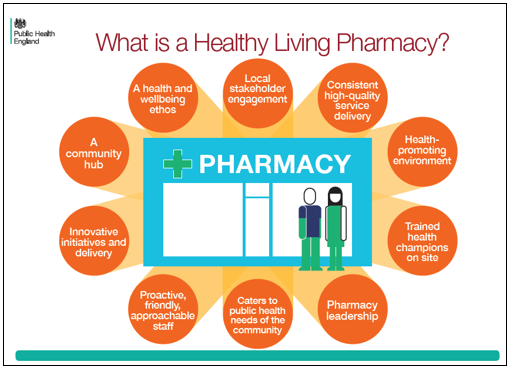
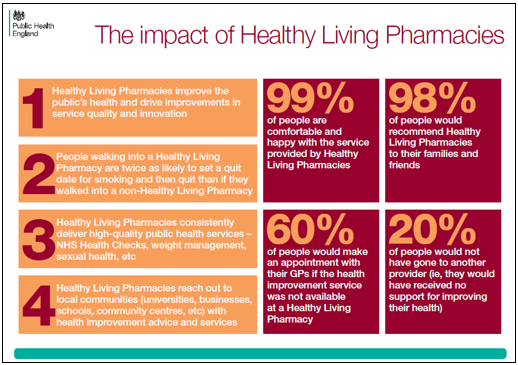
PHE published the below set of infographics in July 2016 to illustrate the role of HLPs in the health and care system.
Evaluation of the HLP pathfinder sites
The evaluation of the HLP pathfinder sites was published in April 2013. The key findings were:
- Early results seen in Portsmouth can be replicated in other areas of the country as the benefits of the scheme were shown not to be dependent on levels of local health need and deprivation;
- The HLP concept was consistent with increased service delivery and improved quality measures and outcomes;
- 21% of people surveyed wouldn’t have done anything if they hadn’t accessed a service or support in the HLP so would have missed out on the benefit of getting advice to improve their health and wellbeing;
- 60% of people surveyed would have otherwise gone to a GP;
- Public feedback was positive with 98% saying they would recommend the service to others and 99% were comfortable to receive the service in the pharmacy;
- More people successfully quit smoking in HLPs than non-HLPs or prior to becoming an HLP;
- The number of people who accessed sexual health services and were provided with additional sexual health advice was greater than in non-HLPs;
- The acceptability of community pharmacy as a location for clients to receive an alcohol service and the relatively high levels of activity seen in HLPs compared with non-HLPs showed that HLPs could have an important contribution to this harm reduction service;
- HLPs were effective at delivering increased support for people taking medicines for long term conditions, through both Medicines Use Reviews and the New Medicine Service. Activity was higher for both services in HLPs than non-HLPs or before HLP implementation in all but one site; and
- Pharmacies were also positive about the scheme; 70% of the pharmacy owners surveyed said it had been worthwhile for their business.
HLP evaluation executive summary
HLP evaluation (full document)
Other evaluations of HLPs
Teeside University – An evaluation of the Tees Healthy Living Pharmacy Pilot Scheme (August 2013)
Pharmacy owners were required to become an HLP in 2020/21 as agreed in the five-year CPCF; this reflected the priority attached to public health and prevention work.
On 20th October 2020 new NHS regulations were laid to introduce changes to the Terms of Service for pharmacy owners and these included the HLP requirements. Further information and guidance on the requirements for HLP has been published by NHS England in guidance on the regulations.
Pharmacy owners had to ensure they were compliant with the HLP requirements from 1st January 2021 and the Distance Selling Pharmacy (DSP) website requirements had to be complied with from 1st April 2021.
For new pharmacies that are not yet HLPs
- Read through the HLP section in NHS England’s Regulations Guidance;
- Work through the requirements as set out in the NHS England Regulations Guidance and compile your evidence to enable you to show you meet the requirements. Pharmacy owners can choose to use Community Pharmacy England’s HLP Evidence Portfolio Workbook (this can be found below) to support them to meet the requirements of the Terms of Service; and
- Then follow the actions to take once a pharmacy owner has met the HLP requirement as detailed below.
HLP Evidence Portfolio Workbook (Word)
HLP Evidence Portfolio Workbook (PDF)
Actions once a pharmacy owner has met the requirements for HLP
Once a pharmacy owner has met all the requirements for becoming an HLP, they should complete an assessment of compliance and retain this in the pharmacy.
Assessment of compliance (Word e-form)
Assessment of compliance (PDF)
This form must be completed by a pharmacy professional (pharmacist or pharmacy technician) in the pharmacy, who must provide their General Pharmaceutical Council registration number.
Part 1 of the assessment of compliance relates to the key requirements that the pharmacy must have in place before self-declaring HLP status. The assessment allows the pharmacy owner to list the evidence they possess in the pharmacy, which they can use to demonstrate compliance with the requirements. Evidence must be provided against all requirements.
Note: Pharmacy owners who have used the Community Pharmacy England HLP Evidence Portfolio Workbook will not need to complete Part 1 of the assessment of compliance provided they have listed all their evidence to meet the HLP requirements in the Workbook.
Part 2 requires the pharmacy professional to declare compliance with the HLP requirements and to retain this in the pharmacy (they do not need to register as an HLP with an external organisation). The assessment of compliance does not need to be submitted routinely to NHS England.
Royal Society for Public Health register and quality assurance visits
Previously, the Royal Society for Public Health (RSPH) was commissioned by Public Health England to maintain an HLP register and conduct quality assurance visits. The RSPH register of HLPs no longer exists and the associated quality assurance process has ceased. Any quality assurance of pharmacies claiming to meet the HLP requirement, would in future be undertaken as part of normal contract monitoring activity conducted by local NHS contract management teams.
Since RSPH is no longer commissioned to provide the HLP register and conduct quality assurance visits, this also means that pharmacies will not be sent an HLP certificate or HLP logo to display in their pharmacy.
Portfolio of evidence
All pharmacy owners will need to retain at the pharmacy a portfolio of evidence together with a completed assessment of compliance signed by a pharmacist to demonstrate that they meet the HLP requirements. The portfolio should continue to be updated with evidence of activities, such as health promotion events undertaken, to demonstrate ongoing compliance with the requirements.
The requirements apply to all pharmacies, including distance selling pharmacies (DSPs), except where specifically noted that different requirements apply to DSPs.
Pharmacies will no longer be required to comply with the PHE Quality Criteria to achieve HLP status, as these have been superseded by the amendments to the Terms of Service and the regulations guidance.
The requirements for pharmacy owners are detailed below under the three sections:
- Workforce development
- Engagement
- Premises requirements
1. Workforce development
This HLP enabler outlines the requirements for pharmacy owners to support the development of staff so they are well equipped to understand public health needs, spread a health and wellbeing ethos, demonstrate team leadership and can communicate appropriate health and wellbeing information to patients and the public.
Public health needs
All patient-facing pharmacy staff must have an awareness of the public health and pharmaceutical needs of the population they serve.
Pharmacy owners must therefore:
- Consider the ways in which they engage with their local community, so they can seek to meet the needs of the local area and help address health inequalities, including targeting deprived communities. This may include the use of virtual and digital communication, as well as provision of face-to-face public health promoting interventions.
- DSPs will provide services to patients in a wider geographical area than that of most other pharmacies, so they will need to reflect on the broad health needs of their patients wherever they may live, rather than those living in a specific local area, for example by seeking information on the health profile of their patients when undertaking patient experience surveys or similar.
Health and wellbeing ethos
All patient-facing pharmacy staff must understand the basic principles of health and wellbeing, and that every interaction is an opportunity for a health promoting intervention.
Pharmacy owners must ensure that:
- They have at least one member of the patient-facing pharmacy staff (one Full Time Equivalent) that has completed the training and assessment of the RSPH Level 2 Award ‘Understanding Health Improvement’ and is therefore a qualified Health Champion.
- Where a pharmacy has less than one full time equivalent patient-facing staff member, excluding the responsible pharmacist, at least one staff member should complete the training and assessment.
- Where a Health Champion leaves the employment of the pharmacy owner and this means no trained Health Champion is in post, the pharmacy owner must put in place an action plan to recruit or train a staff member as a Health Champion as soon as possible and within six months at the latest, of the previous staff member leaving.
Team leadership
Pharmacy owners must have an appointed health and wellbeing leader from the pharmacy team that has undergone leadership training internally or through an organisation that maps to/encompasses the following domains:
- inspiring a shared purpose;
- sharing the vision;
- engaging the team;
- developing capability; and
- influencing for results.
Where a health and wellbeing leader leaves the employment of the pharmacy owner and this means no trained health and wellbeing leader is in post, the pharmacy owner must put in place an action plan to recruit or train a staff member as a health and wellbeing leader as soon as possible and within six months at the latest of the previous staff member leaving.
Communication
With regards to the promotion of healthy living, pharmacy owners must therefore ensure that:
- All patient-facing pharmacy staff can use the NHS website and other appropriate public health information sources, e.g. DHSC Resource Centre, when providing advice on health issues and where appropriate;
- The patient-facing pharmacy staff are friendly, welcoming and sensitive to the need for privacy for different individuals seeking advice including respecting people’s values and beliefs;
- The patient-facing pharmacy staff routinely explain who they are, wear a name badge and inform people about the information and/or services on offer;
- All patient-facing pharmacy staff receive training on how to approach people to discuss difficult or sensitive public health issues;
- All patient-facing pharmacy staff are able to provide brief health and wellbeing advice (2-3 minutes) and have an awareness that the person may need additional support for behavioural change; and
- When communicating with patients and the public and offering advice on difficult or sensitive issues, pharmacy owners and staff need to consider how they offer and maintain patient privacy. The approach taken may differ between pharmacy owners depending on the physical structure of the pharmacy, whether they provide services via remote means (e.g. DSPs must have the ability to undertake phone and video consultations. For bricks and mortar pharmacies, while there is no requirement to provide video consultations, transition towards this type of consultation is encouraged), the local population they serve, and other factors.
2. Engagement
This HLP enabler outlines the requirements for pharmacy owners to support patients where they require advice, treatment and/or support.
Under the Signposting service, pharmacy owners are required to signpost or refer patients to other health and care providers if it is clear they require advice, treatment and/or support that the pharmacy owner is unable to provide.
The Public Health (Promotion of Healthy Lifestyles) service includes a requirement for prescription-linked healthy living advice to be provided to patients presenting prescriptions to be dispensed who appear to have diabetes, be at risk of coronary heart disease, smoke or be overweight.
What is different in HLP?
With regards to the promotion of healthy living, pharmacy owners must:
- Proactively engage with patients and the public using the pharmacy, to offer them advice, support and signposting to other providers of services in the community;
- Encourage charities and other providers to work with the pharmacy for delivery of key health messages; and
- Direct patients and the public to health and wellbeing providers and resources appropriate to their needs, where this is necessary (e.g. specialist clinics, Smoking Cessation, Drug and Alcohol Services, Health Trainer Service, weight management services, mental health services, community exercise groups).
Pharmacy owners must also undertake a community engagement exercise at least once per financial year for the promotion of healthy living, which involves:
- Actively working in collaboration with other organisations to deliver pharmacy outreach and any locally commissioned services; and
- Taking prevention and health promotion services beyond the pharmacy premises. Pharmacy outreach may be face to face and take services to people where they live or spend time or may be virtual events.
When pharmacy owners and staff work in collaboration with other community organisations to undertake pharmacy outreach and any commissioned services, the pharmacy owner and the other organisation must undertake a risk assessment prior to the outreach activity to ensure that any activities are undertaken in a safe and culturally competent way.
3. Premises requirements
Pharmacy owners should aim to create a health promoting environment that is reflected by the premises, as well as in the actions and attitudes of the pharmacy staff.
Health promoting environment
To create a health promoting environment, pharmacy owners must ensure:
- It is clear to the public that free, confidential advice on their health and wellbeing can be accessed;
- For pharmacies which are visited by patients and the public, the pharmacy has a dedicated Health Promotion Zone, of sufficient prominence, that contains up-to-date professional health and wellbeing information that meets the needs of the population they serve; and
- Distance Selling Premises (DSPs) must have a website for use by patients and the public accessing their services, which has an interactive page on their website clearly promoted to any user of the website when they first access it, which provides public access to a reasonable range of up to date materials that promote healthy lifestyles, by addressing a reasonable range of health issues. DSPs had to be compliant with this requirement from 1st April 2021.
Pharmacy owners must also ensure they are compliant with NHS England’s Approved Particulars for Premises.
Consultation rooms
Pharmacy premises, other than DSPs, must have a consultation room which is:
- Clearly designated as a room for confidential conversations;
- Distinct from the general public areas of the pharmacy premises; and
- A room where both a person accessing pharmaceutical services and a person performing pharmaceutical services are able to be seated together and communicate confidentially.
Where a pharmacy did not provided any Advanced services at or from the premises during 2020, they were exempt from the requirement to have a consultation room on the premises until 1st April 2023, after which they were also required to have one in place.
Where pharmacy premises, other than DSPs, were too small for a consultation room to be included, the pharmacy owner had to apply to their local NHS England team to request an exemption from this requirement. NHS England considered the information provided by the pharmacy owner and where it was of the opinion that the pharmacy was too small for a consultation room, it confirmed this with the pharmacy owner. The pharmacy owner then had to ensure that they put arrangements in place at the pharmacy which enabled staff and patients to communicate confidentially by telephone or another live audio link and a live video link.
Pharmacy owners were advised to keep a copy of the NHS England decision confirming that the pharmacy owner was exempt from the requirement of having a consultation room on the premises.
Where NHS England was of the opinion that the pharmacy was not too small for a consultation room, the pharmacy owner was advised of this and they would then have needed to have installed a consultation room.
Pharmacy owners who open new pharmacy premises on or after 1st January 2021 will need to have a consultation room from the first day they open for business.
Consultations held from distance selling premises
DSPs must ensure that there are arrangements in place at the pharmacy which enable staff and patients to communicate confidentially by telephone or another live audio link and a live video link.
Sustainability
Pharmacy owners should consider environmental sustainability in the way they operate their business. This may include reducing the use of paper materials and providing more information online. This should only be where online access is appropriate for patient care, for example, some patients may not be able to access online materials. Pharmacy owners could also consider highlighting to patients the environmental benefit of returning used inhalers to the pharmacy for safe disposal via the Disposal of unwanted medicines service.
For more information on what the NHS is doing to become more environmentally sustainable, pharmacy owners can read the NHS England Delivering a net zero NHS document.
Pharmacy owners may need to use this evidence during local NHS contract management team contract monitoring activities or during discussions with other organisations, such as the General Pharmaceutical Council or the local authority.
To ensure pharmacy owners continue to meet their Terms of Service requirements, it is recommended they review their compliance against the requirements at least every 3 years.
Community Pharmacy England resources
Community Pharmacy England Briefing 042/20: How to become a Healthy Living Pharmacy (HLP) and maintain that status (updated November 2020) – this sets out the requirements that pharmacies must meet to achieve HLP status or maintain their HLP status. Pharmacy teams must be able to provide evidence of their behaviours and activities as well as the physical environment.
A flow chart detailing the process to follow to achieve HLP status or maintain HLP status is available below:
Below is a checklist of the requirements which pharmacy teams need to achieve to gain HLP status. The checklist can also be used to review ongoing compliance with the Terms of Service requirements to maintain HLP status :
The following HLP Evidence Portfolio Workbook can be used to guide pharmacy teams through the HLP requirements and assist them with recording their evidence to show they have met them.
HLP Evidence Portfolio Workbook (Word)
HLP Evidence Portfolio Workbook (PDF)
Once a pharmacy owner has met all the requirements for becoming an HLP, they should complete an assessment of compliance and retain this in the pharmacy.
Assessment of compliance (Word e-form)
Assessment of compliance (PDF)
Additional Community Pharmacy England resources
Holding health promotion events/campaigns and documenting details of these are a way for pharmacy teams to demonstrate that they meet several of the quality criteria that pharmacy teams need to meet to achieve and maintain HLP status.
To assist pharmacy teams when planning a health promotion event/campaign, a suggested checklist can be found below:
Checklist for holding a health promotion event campaign (Word)
Checklist for holding a health promotion event campaign (PDF)
Pharmacy teams may wish to use a questionnaire to help them evaluate their health promotion event/campaign and to make improvements to future events/campaigns. A template questionnaire can be found below:
Event campaign questionnaire (Word)
Event campaign questionnaire (PDF)
Other resources for pharmacy owners and their teams
Everyday Interactions (RSPH and PHE) is a toolkit which can help healthcare professionals record and measure their impact on public health. This toolkit can be used by pharmacy team members to record and collate their interactions with patients and add to the pharmacy’s portfolio of evidence of meeting HLP standards.
The toolkit contains impact pathways relating to different public health topics such as obesity, alcohol consumption, smoking and sexual health. There is also a short e-learning resource to support you to use the toolkit.
e-Learning for Healthcare: Making Every Contact Count e-learning – A web-based learning resource for frontline staff. It has been developed by Health Education England’s local team in the West Midlands in collaboration with Public Health England West Midlands. The e-learning is available using the above link without the need to register. Pharmacy owners who would like to evidence training can register team members with the e-Learning for Healthcare website and enrol on the course.
The role of the Health Champion – This document provides more information on the role of the Health Champion, who can become a Health Champion and the training available.
Pharmacy staff that wish to become a Health Champion have to have undertaken the RSPH Level 2 Award in Understanding Health Improvement.
There are several organisations that provide HLP training for pharmacy staff and those that Community Pharmacy England has been made aware of are listed below for information (listing on this website does not constitute an endorsement of the course or provider by Community Pharmacy England):
Centre for Pharmacy Postgraduate Education
A PowerPoint presentation for LPCs on HLPs can be used by LPCs/community pharmacists as the basis for a presentation on the HLP concept to:
- Local patient groups;
- Local government officers and councillors; and
- other groups that have an interest in community pharmacy.
The why, the how and the what – This document provides more information on HLPs.
Information for GP practices – Further information on HLPs aimed specifically at GP practices.
Information for LAs – Further information on HLPs aimed specifically at local authorities.
This section contains frequently asked questions regarding pharmacies achieving and maintaining HLP status.
Q. How often (if at all) will the leadership and RSPH training need to be repeated?
There is no requirement to repeat training in the HLP requirements; as long as a pharmacy owner has staff in post that have undertaken the relevant training, that will meet the requirements.
Q. The HLP requirements has a criterion which states that the pharmacy team actively works in collaboration with other community organisations to deliver pharmacy outreach and/or services. Can this be done in the pharmacy, as part of a regular health promotion event or do the pharmacy staff have to undertake an event/service away from the pharmacy premises?
The outreach work needs to be carried out off the pharmacy premises, so while it would be good to have collaborative working on the premises, collaborative working off-premises would satisfy that requirement. HLPs have previously done that via attendance at local roadshows for the public, stands in shopping centres, visits to schools and care homes to take part in health promotion work. This could also be achieved using remote presentations.
Q. What constitutes a full-time equivalent (FTE) member of staff?
FTE is the hours worked by one employee on a full-time basis. The GOV.UK website states there is no specific number of hours that makes someone full or part-time, but a full-time worker will usually work 35 hours or more a week.
Q. Is attendance at face-to-face RSPH training a requirement to qualify for HLP Health Champion training?
The requirements to qualify for HLP Health Champion training will depend on the training provider that the pharmacy owner has chosen to use and how their course has been designed to meet the RSPH Level 2 Award in Understanding Health Improvement (the course that needs to be completed for someone to become a Health Champion). Therefore, depending on the course provider, face-to-face training may be required as part of their course.
Return to the Essential services hub page
For more information on this topic please email services.team@cpe.org.uk